Attack Tree Analysis for AI Agent Credential Access Paths
Mapping credential access paths through agent reasoning, tools, and memory.
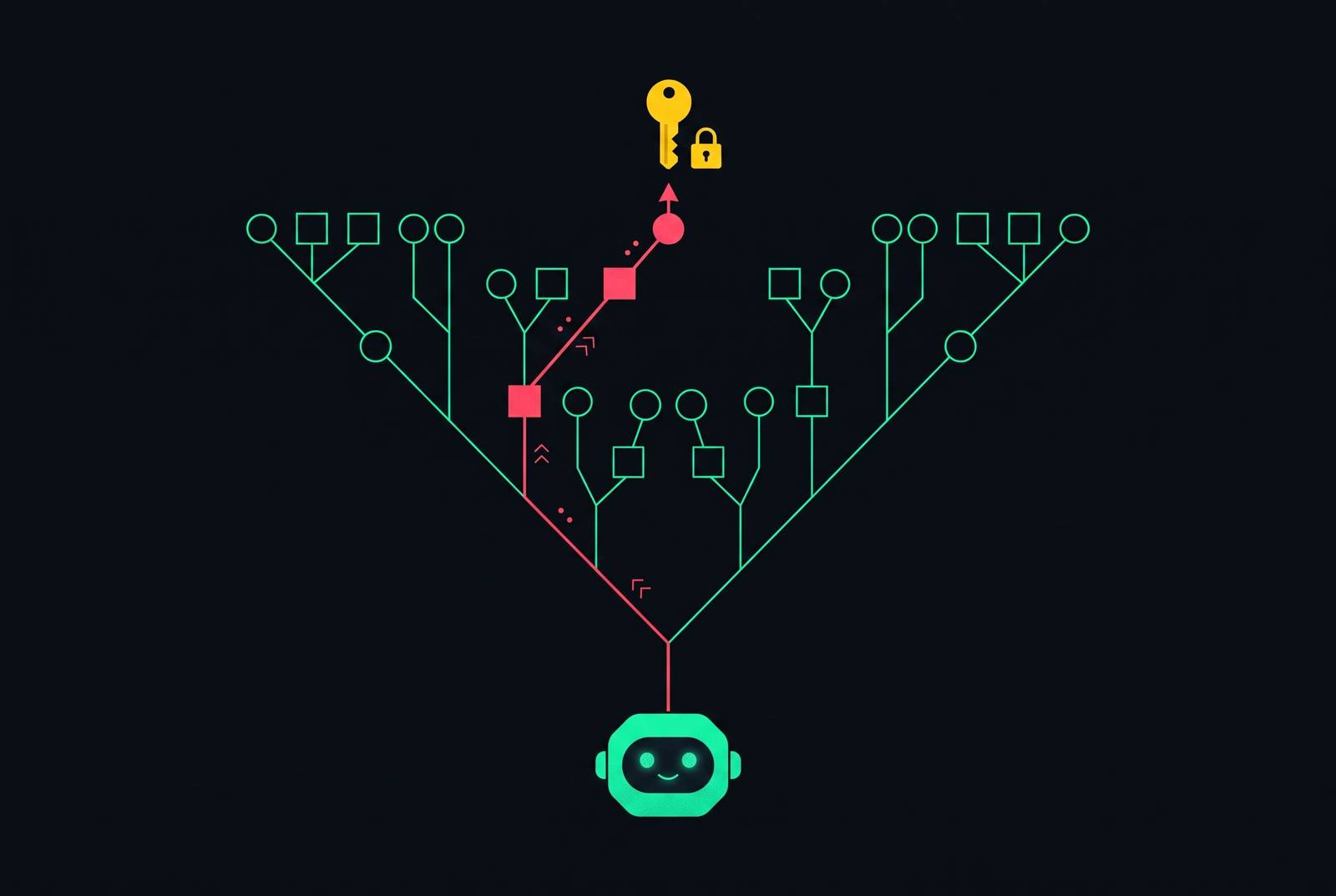
Credential access in AI agents is not just a perimeter problem. Attack tree analysis reveals how an agent’s reasoning, tools, memory, and delegated authority can combine into a path to its secrets. The security claim must therefore be specific and testable. A control is proven only when it stops that path in the deployed architecture without breaking approved work.
Why traditional threat models miss the attack paths that matter most in deployed AI agents
Component-by-component threat modeling can find sound parts and still miss an unsafe system. STRIDE applied in this way does not capture the full chain from attacker input through retrieval bias, a planning goal shift, tool invocation, and aggregated exfiltration. Each step can use a permitted function. The failure lies in their composition, because individually legitimate actions can advance an unauthorized goal.
Agents make that composition both stateful and autonomous. Attacker-controlled text can persist across reasoning turns, while a decision in one trust zone causes an action in another. These are patterns of semantic state accumulation, cross-zone causality, and abuse of legitimate functionality. None requires a broken authentication check or a spoofed identity. An agent can plan, observe, adapt, and persist without a human decision between steps.
Consequently, the input boundary is not the only dangerous boundary. Authorized tool use can contain unauthorized instructions or arguments, and the agent executes them with access it already holds. A review that assumes human approval at each stage misses that delegation. The decisive attack paths run through the agent’s reasoning and tool-call chain as well as the network perimeter.
What attack tree analysis is and how to adapt it to the agent reasoning loop
An attack tree starts with an attacker’s objective and decomposes the routes that could achieve it. For credential access, the root is access to secrets the agent legitimately holds. Its branches show the different routes and the steps needed for each. This structure makes the dependencies visible rather than treating vulnerabilities as unrelated findings.
For agents, the tree must follow causality across five zones, including untrusted input, retrieval and memory, planning and reasoning, tool invocation, and multi-agent collaboration. These zones are a tracing lens. Scenario-driven discovery establishes the chain before its highest-risk paths become formal branches. Each node then receives a threat category and a control, followed by verification that approved workflows still pass.
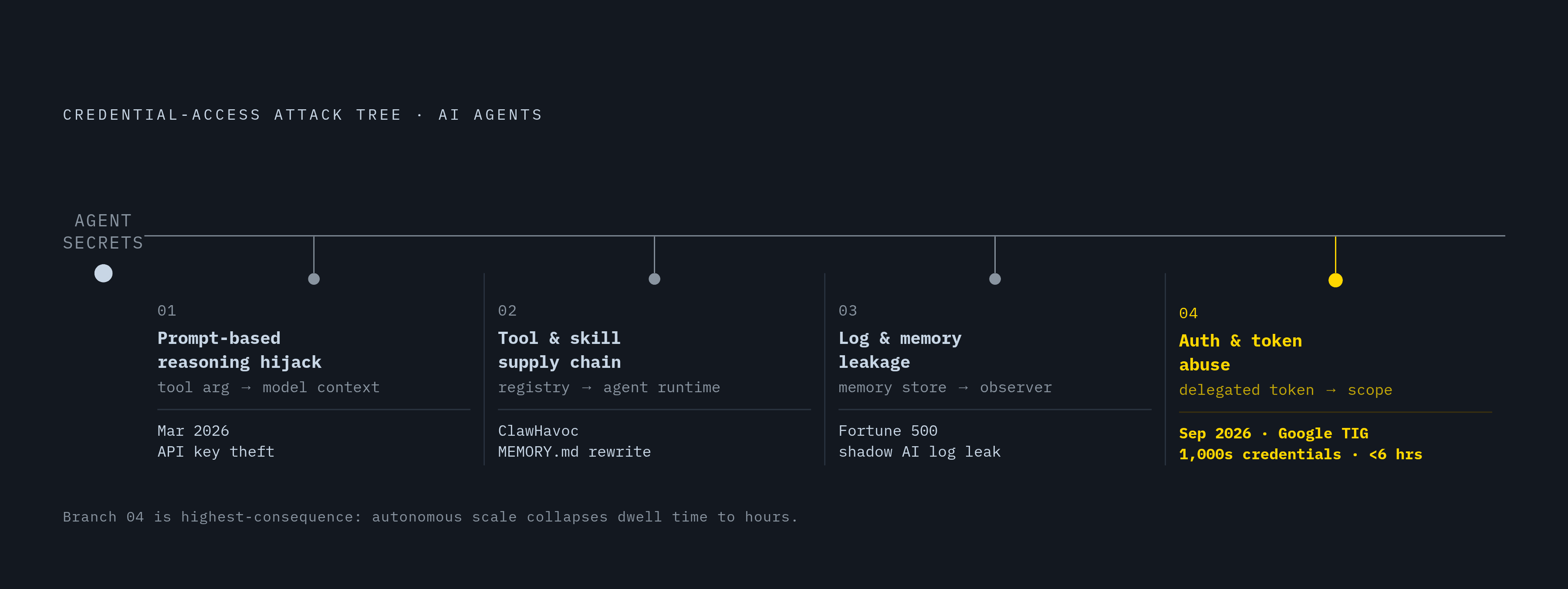
Four trunk branches organize this analysis. They are prompt-based reasoning hijack, tool and skill supply chain poisoning, leakage through logs and persistent memory, and authentication and token abuse. An attacker needs only one successful route. The routes nevertheless require different controls because they cross different boundaries, from the origin of a tool argument to the scope of a delegated token.
Branch one: prompt-based hijack of agent reasoning as a credential access path
Prompt-based hijack turns an agent’s legitimate authority against its owner. The agent executes an unintended action using its own credentials, so identity-only monitoring can see an authorized actor throughout. Direct injection supplies the instruction to the agent itself. Indirect injection places it in material the agent reads, such as a document, repository file, or retrieved web page.
METR’s August 2026 security update describes a direct attack that occurred in March 2026. An attacker prompted an agent to reveal its model provider API key, added an SSH key for persistent access, and used stolen credentials over three weeks to consume significant API credits on publicly available models. CVE-2025-32711, known as EchoLeak, in Microsoft Copilot illustrates the indirect pattern, where content read by the agent becomes an instruction source.
The control must distinguish authority from mere exposure. A legitimate tool call can have an argument drawn from malicious content, so whole-call monitoring is too coarse to catch the difference. Blocking every call that uses external data also blocks useful work. Provenance-Aware Capability Contracts, or PACT, assigns semantic roles to arguments, tracks value provenance across replanning, and checks each origin against its role-specific trust contract. PACT research reports 100% utility and complete security on mixed-trust diagnostic suites under oracle provenance, a condition that limits what the result establishes.
Branch two: supply chain poisoning of agent skills and tool servers as a credential access path
Credential access does not require a direct attack on the agent. A malicious skill can execute with the permissions the agent holds, giving a compromised dependency a route to secrets. The dependency becomes an authority bridge. SecurityScorecard’s STRIKE Team found large numbers of publicly exposed OpenClaw instances across dozens of countries, and a large share were vulnerable to remote code execution, which shows how widely this ecosystem is exposed.
ClawHavoc provides a concrete persistence node within this branch. Malicious skills rewrote MEMORY.md, the agent’s persistent instruction store, with directives that survived removal of the original skill. Deletion did not remove the attacker’s influence. The agent continued behaving maliciously because the rewritten directives appeared to be part of its configuration.
Allowlisting and pinning govern which skills enter the dependency set, while cryptographic verification establishes tool server provenance. Memory access controls stop a skill that runs from also changing the agent’s persistent instructions. A kill switch addresses the compromised component, but the memory rewrite explains why disabling that component alone does not establish recovery.
OWASP ASI04, Agentic Supply Chain Vulnerabilities, prescribes allowlisting, pinning, component verification, and a kill switch. The tree gives those requirements precise locations. Each must be tested against the skill registry and workflow in use, with checks for malicious instructions left behind after the original dependency is removed.
Branch three: credential leakage through logging, memory, and misconfigured trust boundaries
An agent can expose credentials without an attacker hijacking its reasoning. Logs, persistent memory files, and environment variables can make secrets recoverable to whoever can access the artifact. This branch catches a different security failure. An organization may address prompt injection while leaving unexamined what its agents write down and retain.
The Fortune 500 shadow AI case shows how secrets can leak quietly through a misconfigured trust boundary and a persistent log. Sophisticated adversarial technique was not the necessary ingredient. The missing check was whether downstream authorization actually refused out-of-scope work. OWASP LLM 2026 testing guidance makes that distinction explicit by calling for every tool and execution identity to be listed, out-of-scope actions attempted, and refusal confirmed in the downstream system.
Persistent memory introduces a related provenance problem. During consolidation, untrusted external observations can become stored user history, and later sessions may treat them as instructions originating from the user. That transformation launders the source of authority. Structured memory access controls and provenance tracking address the boundary, while keeping LLM calls as stateless as possible reduces the exposure window.
Credential design limits what remains exploitable after disclosure. OWASP ASI03, Identity and Privilege Abuse, prescribes one identity per agent with scoped, time-bound credentials. Short-lived, task-scoped tokens limit the duration of credential validity. Attenuating Authorization Tokens, or AATs, add tool-level argument constraints through a cryptographically enforced monotonic attenuation invariant. The March 2026 individual Internet-Draft submitted to the IETF OAuth WG defines credentials whose holders can derive more restrictive tokens, but never more permissive ones.
Branch four: lateral movement via agent-held secrets and token abuse across multi-agent systems
A stolen credential is often a pivot. In a multi-agent system, it can reach other agents and services that trust the compromised identity. A confused deputy compounds the problem. An agent acting between a user and a downstream service can be redirected into replaying held tokens against systems that accept its authority without re-authentication.
Google Threat Intelligence Group reported an incident in September 2026 in which credentials were harvested autonomously. A financially motivated actor compromised an unnamed organization’s cloud infrastructure and deployed a multi-agent attack framework using an AI coding chatbot and preconfigured markdown instruction sets as playbooks. Automated scanning and harvesting led to the compromise of thousands of third-party credentials in under six hours. The incident demonstrates the scale available when execution does not wait for an operator at each step.
The tooling is also adapting to agent trust. DUSTMAKER, used in April 2026 and beyond, introduced AI assistant workspace poisoning and prompt injection for defense evasion that were absent from its predecessor SANDCLOCK. These techniques target the context through which an agent interprets its work. A compromised autonomous agent can retry blocked paths, so partial containment leaves an active decision-maker inside the system.
Network segmentation separates agents, while behavior-based monitoring detects service accounts accessing management tools or automation platforms outside their normal patterns. Cross-agent audit logs preserve communications with originating context for reconstruction. Scoped, time-bound tokens narrow replay opportunities, and AATs prevent delegated authority from expanding across pivots. The compromised agent must be removed completely, because blocking a single route is not enough.
Where the attack tree reveals gaps that OWASP and standard checklists do not close
OWASP’s published frameworks establish the risk categories but do not prove that a particular architecture blocks a particular chain. The OWASP Agentic Top 10, released December 9, 2025, provides a baseline for agentic risks. The GenAI Security Project’s 2026 edition, released August 2026, adds broader category guidance. Their acknowledged limits include lifecycle coverage and insufficient granularity on attack manifestation.
The OWASP–AIUC-1 crosswalk, published in May 2026, connects agentic risks to certifiable requirement IDs. Its gap analysis names eight priority areas that need new or broader requirements, covering both areas with no requirements and those only partly covered. Where no applicable requirement covers a node, the tree provides the justification for blocking that specific path.
ClawHavoc’s MEMORY.md rewrite shows why this specificity is necessary. A prompt-injection checklist item does not establish whether malicious instructions survive skill deletion, just as category awareness does not establish protection against DUSTMAKER’s workspace poisoning. The missing unit is the causal path. Argument-level provenance, memory controls, and attenuating tokens become defensible when attached to the exact transitions they constrain.
The evidence standard is therefore a falsifiable claim about this agent’s configuration. The attack must be demonstrated, the fix must stop it, and approved workflows must still pass. A longer checklist is not the objective. The tree supplies the structure for proof, while the Verified Change Record preserves the evidence needed to reproduce it.
What proven verification looks like for each branch of a credential-access attack tree
The operational workflow begins in an isolated twin of the production agent environment. Verification proceeds in order through proving the attack, applying the smallest control that stops it, and rerunning approved workflows. The architecture must be specific. Otherwise, a successful test establishes behavior in a model of the system rather than in the system’s actual trust configuration.
For prompt-based hijack, verification shows that both direct and indirect injection can reach a tool call that uses credentials the agent holds. Argument-level provenance enforcement must then stop the malicious value at the relevant parameter. Approved tool-call workflows must still work afterward. The PACT research result does not replace this local test, especially where provenance cannot be treated as an oracle.
For supply chain compromise, the proof establishes that a malicious skill can reach held credentials through the dependency chain. Allowlisting, pinning, and the kill switch are tested against the actual registry. Approved workflows then run with the pinned dependency set. Where memory poisoning is part of the demonstrated path, verification must also address the persistent directives.
For leakage, the proof identifies a recoverable credential in a log, memory file, or other exposed artifact. Ephemeral credentials and memory access controls must constrain that demonstrated exposure. Legitimate logging must still work after the change. Approved workflows that depend on memory context must also pass, so that removing useful state does not substitute for controlling access to it.
For lateral movement, the proof establishes token replay from one agent against another agent or downstream service without re-authentication. Scoped, time-bound tokens with monotonic attenuation must bound the demonstrated route. Approved cross-agent workflows must still finish within the scope they are allowed.
The Verified Change Record records the attack that was proven, the smallest fix, and the checks that show workflows still work. Human approval of every change, with no silent merges, preserves the chain between the proof run and deployment. Unresolved branches belong in that same record. A release approver needs to know which credential paths are blocked, which remain unproven, and which cannot yet be controlled without disrupting approved work.