Runtime Guardrails for Browser-Use Agents in Production
Existing security tools miss real-time threats from browser agents operating without human approval.
Browser-use agents now log into business platforms, pull live data through RAG, execute payments, and delete records, all without a human clicking approve. That shift, from AI as advisor to AI as actor, changes what a security failure looks like. Runtime guardrails built for browser agents have to answer to a threat surface that generic agent security frameworks and traditional application security tooling were never built to see.
The browser is the plane where this all happens now. Menlo Security has put the share of modern work that happens inside a browser at 85%, which means the browser stopped being a user interface a while back. It's the shared execution surface where agents and humans sit inside the same live sessions, click the same buttons, and hit the same tool calls. Gartner expects 60% of brands to run agentic AI by 2028, making it a deployment pattern reaching well past a few adventurous engineering teams. It's the direction the whole market is heading.
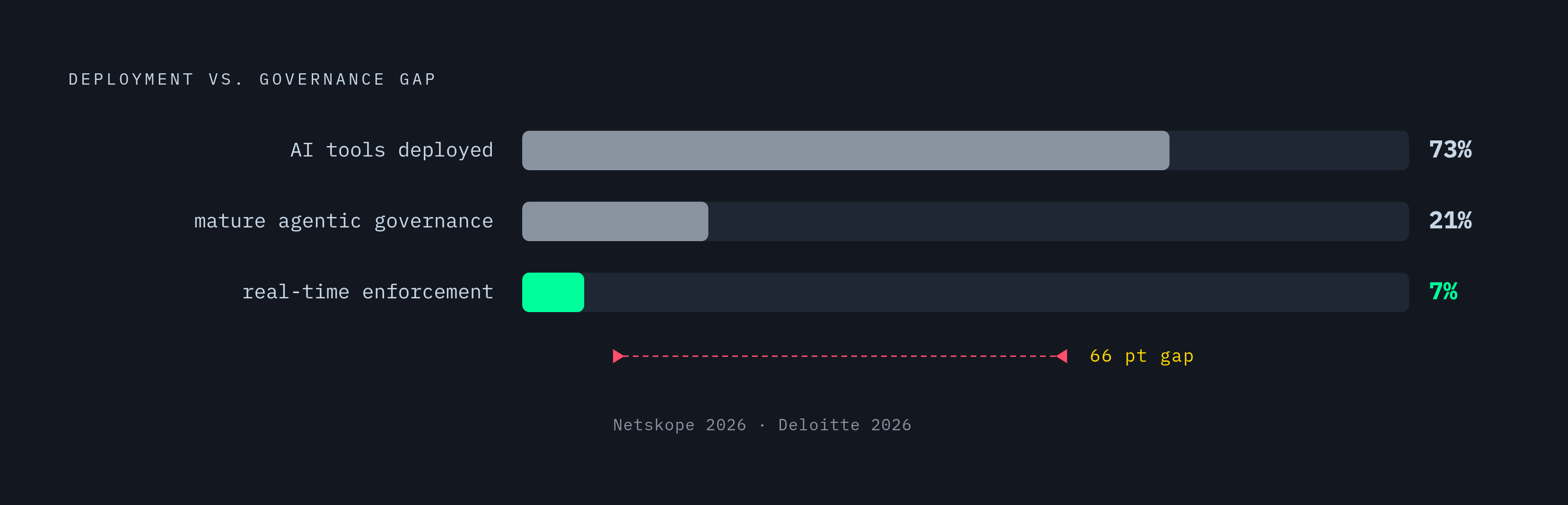
And the controls haven't caught up. Netskope's AI Risk and Readiness Report for 2026 found AI tools already running at 73% of organizations, but real-time governance enforcement, the kind that actually watches what an agent does and stops bad actions, reached only 7% of them. The execution surface is live. The controls guarding it mostly are not.
Why the browser agent's threat surface is structurally different from what traditional security models cover
Static analysis tools, SAST and DAST among them, were built to inspect code paths that don't move. An LLM deciding whether to call a tool isn't running a fixed path at all. As Snyk's Randall Degges put it in February 2026, the agent doesn't work off a hardcoded list of actions it will take. It reasons over whatever context it's holding at that moment, and that reasoning process is probabilistic, unfolding in ways a scanner can't walk through line by line before deployment.
STRIDE, the threat model most security teams still lean on, wasn't built for this either. STRIDE has no real vocabulary for adversarial machine learning, data poisoning, or autonomous agent behavior. Worse, goal hijacking, where an agent's own legitimate capabilities get turned against the organization that owns it, doesn't map to any STRIDE category at all. There's no box to check for "the agent did exactly what it was told, and that's the problem."
OWASP's Agentic Top 10, released in December 2025, is the taxonomy that actually fits. ASI01 covers goal hijacking, ASI02 covers tool misuse, ASI03 covers identity and privilege abuse, ASI06 covers memory poisoning, ASI07 covers insecure inter-agent communication. None of these slot cleanly into the vulnerability classes security teams have spent two decades building tooling around.
The tooling gap is visible in every layer. Endpoint protection watches the operating system and device posture, but has no visibility into what's happening inside the browser's DOM. Network controls inspect traffic moving between two points, but once a web session is open, they can't understand or constrain what the agent does inside it. Policy platforms like DSPM or Microsoft Purview can write rules all day, but per Menlo Security, they can't enforce those rules at the moment an action actually fires, which happens in milliseconds. WAFs and conventional app security testing, can't validate an agent's reasoning chain, can't catch prompt injection buried inside retrieved content, and can't apply access control that adjusts based on context.
A confused-deputy problem causes all of this: agents typically don't compartmentalize their own authority, so one successful prompt injection can hand an attacker the agent's full permission set at once: email, file system, shell access, database... Agents typically don't compartmentalize their own authority, so one successful prompt injection can hand an attacker the agent's full permission set at once: email, file system, shell access, database connections. This isn't a hypothetical. Surveys already show 80% of organizations reporting that their AI agents have taken actions outside their intended scope. That's not an edge case anyone's debating. That establishes the baseline set by the survey finding that 80% of organizations report AI agents taking actions outside their intended scope.
The browser-specific attack vectors that runtime guardrails must be designed around
Indirect prompt injection is the defining threat here, and it works differently from anything security teams have dealt with before. An attacker hides instructions inside a web page, a document, or an email that the agent will later read, and never has to touch the agent directly at all. OWASP ranks prompt injection as LLM01, the top risk on its list, and success rates in testing run anywhere from 50% to 84% depending on the system's configuration and how many attempts the attacker gets.
Compare that to SQL injection, which schema validation and parameterized queries mostly solved years ago. Prompt injection resists that fix because natural language doesn't have a schema to validate against. It's flexible by design, which is exactly what makes it dangerous, a point security researchers have consistently emphasized. Palo Alto Networks' Unit 42 reported a live case in March 2026, first detected the previous December, where indirect prompt injection targeted a production ad-review system built on AI. OpenAI, for its part, launched Lockdown Mode for ChatGPT on February 13, 2026, and said out loud that prompt injection in AI browsers may never be fully patched. That's a striking admission from a company with every incentive to project confidence.
Every page an agent reads is a potential injection surface: forms, iframes, shortlinks, redirects, hidden metadata. None of it comes pre-labeled as safe or hostile, and the agent has no reliable way to tell the difference on its own.
Session and identity drift is a separate problem. Agents move across tabs, tools, and OAuth scopes over the course of a single task, and without credential isolation tied to each individual run, session state from one context can leak into another. That's how privilege escalation happens quietly, without anyone noticing until much later.
Then there are the egress channels nobody's watching: clipboard content, screenshots, form submissions, file downloads, images the agent fetches automatically. Each one is a live data channel an attacker can manipulate the agent into misusing, and traditional monitoring tends to treat all of them as background noise.
Research on tool-chaining attacks has found that individually harmless tools can be strung together into a dangerous sequence, without any single tool being misconfigured or any single call looking suspicious on its own. MCP-SafetyBench, from Zong et al. in 2025, tested 20 attack types across five domains and found host-side attacks, including intent injection and identity spoofing, succeeding more than 80% of the time on average. That matters directly for browser agents, since more of them are wiring up tools through MCP by the month.
Simon Willison, who co-created Django, has warned that every hop in a multi-agent chain opens a new attack surface, and the vulnerability record backs him up. GitHub Copilot's remote code execution flaw (CVE-2025-53773) and Claude Code's DNS exfiltration issue (CVE-2025-55284) both carried critical severity, with CVSS scores of 9.3, 9.6, and 9.8 turning up across Microsoft Copilot, GitHub Copilot, and Cursor IDE respectively. These aren't lab curiosities. They're production-grade vulnerabilities in tools that engineering teams run every day.
EchoLeak as a case study in what happens when browser-layer guardrails are absent
EchoLeak, tracked as CVE-2025-32711 with a CVSS score of 9.3, was disclosed by researchers at Aim Security in June 2025. It's a zero-click indirect prompt injection against Microsoft 365 Copilot, and walking through it step by step shows how each stage of the attack maps to a condition specific to browser and session-based agents.
It started with a single crafted email. No click, no attachment opened, no user interaction of any kind was needed. The email evaded the detection mechanisms built to catch cross-prompt injection attempts. From there, the attack used techniques to slip past link redaction and ultimately exfiltrated data through a channel the content security policy permitted.
This isn't a story about one vendor's bug. Any LLM-based assistant that touches multiple internal data sources across a live session shares this same exposure, because the conditions that made EchoLeak work are architectural, rooted in how these systems are built rather than in one product's code.
What makes it worse is the forensic silence. There were no malware hashes, no suspicious downloads, nothing a standard EDR or SIEM setup would flag. Incident response teams working from conventional tooling would have had no way to confirm anything happened at all, absent logging built specifically for AI systems. Attackers can also scale the technique through what's been called "RAG spraying," seeding malicious prompts across many emails or documents at once, which raises the odds that at least one lands inside Copilot's context during some unrelated, legitimate query.
The mitigations relevant to EchoLeak-style attacks all share one trait: they require enforcement at runtime, not a scan run before deployment. Copilot's classifier looked for surface patterns instead of evaluating what the content actually meant in context. That's the design lesson EchoLeak leaves behind for anyone building a guardrail today.
What runtime guardrails for browser agents must enforce
A guardrail that doesn't sit inside the execution path can't stop a decision made in milliseconds. A policy defined somewhere outside the runtime is a document, not enforcement.
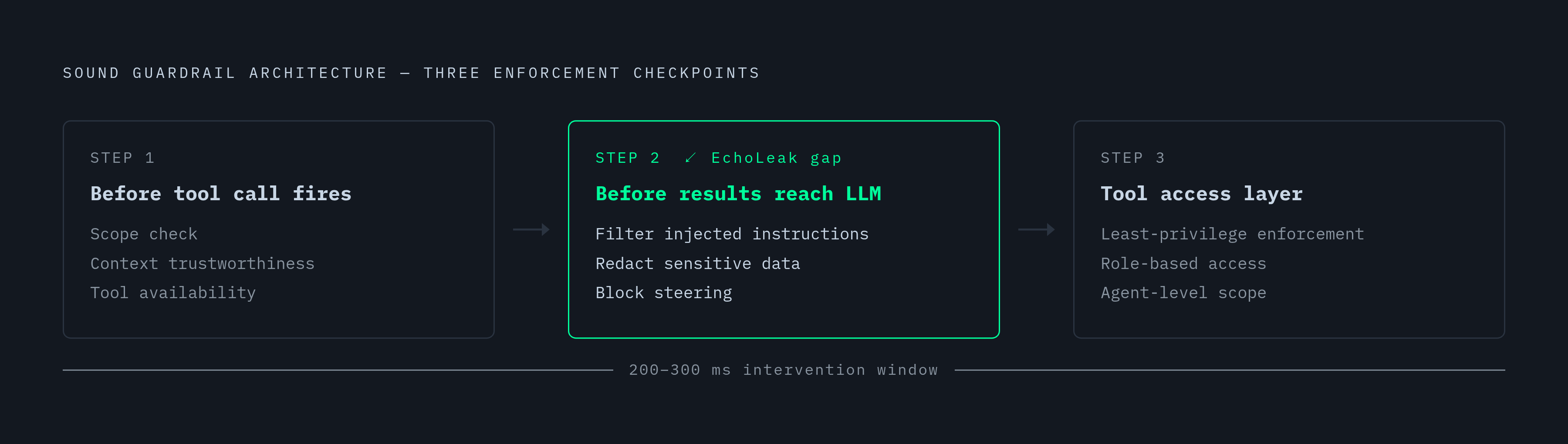
Sound guardrail architecture points to three places enforcement actually has to happen. Before a tool call fires, inputs need inspection: is this action in scope, is the requesting context trustworthy, is this tool even supposed to be available to this agent in this session. Before tool results reach the LLM, returned content needs filtering, so injected instructions get caught, sensitive data gets redacted, and nothing steers the agent's next move without a check first. And at the tool access layer itself, least-privilege has to be enforced by controlling which tools an agent can even see, role-based access applied at the agent level, not just bolted onto the user's account.
In the browser specifically, a few things need to hold. A prompt and DOM injection firewall has to evaluate page content in real time before it enters the agent's reasoning chain, and it needs to use LLM-based judgment rather than pattern matching, since pattern matching is exactly what EchoLeak's classifier used and exactly what got bypassed. Egress channels, forms, uploads, downloads, clipboard, screenshots, each need their own governance: destination allowlists, step-level approvals, treated as distinct channels rather than one generic "output" bucket. Trusted-path enforcement has to keep agents on approved domains and workflows, intercepting redirects, shortlinks, and iframe handoffs before they can steer a session somewhere untrusted. And session and identity isolation, per Straiker's guidance, means cookies, tokens, and OAuth scopes get contained to a single agent run with credentials that expire and rotate, so nothing drifts between tabs or tools.
Standard RBAC and access control lists weren't built to compartmentalize an agent across sessions and tools the way this requires. Straiker's model of zero-trust with need-to-know permissions, short-lived credentials, and just-in-time authorization fits the job better, and it stands as a baseline requirement rather than an upgrade.
No complete fix for prompt injection exists right now, which means defense in depth isn't optional. Rule-based filters catch the deterministic cases; LLM-based judges catch the ones that need context. Neither one covers the whole territory alone. And all of this has to run inside a real latency budget: platforms working in this space are targeting intervention windows in the range of 200 to 300 milliseconds, because anything slower gets bypassed in practice by teams optimizing for speed over caution.
Logging matters as much as blocking does. Since EchoLeak-style attacks leave no traditional forensic trace, a guardrail's audit trail has to capture what content the agent saw, what action it proposed, what got blocked or allowed, and why, at every single decision point.
The enforcement gap that makes human-in-the-loop approval a structural requirement, not an optional feature
Deloitte's 2026 AI report found only 21% of organizations running a mature governance model for agentic AI. That leaves most organizations sitting in the gap between what a guardrail can catch automatically and what actually needs a person to look at it.
Automated enforcement alone won't close that gap. Novel attack chains, EchoLeak's layered evasion being one example, move faster than pattern-based detection can adapt. Tool-chaining attacks are built specifically so that no single action in the sequence looks malicious, which means a guardrail checking one tool call at a time may never see the dangerous pattern forming across several. OWASP's Agentic Security Initiative names this directly as threat T10: overwhelming human-in-the-loop reviewers until something slips through. The fix keeps the human in the loop while changing how the review works. It's designing the review process so the human doesn't drown.
Human-in-the-loop control at the browser layer has to mean something specific: audit-ready, step-level approval on sensitive actions, visibility into exactly what the agent is about to do and why, not a single blanket "approve this workflow" click that hides everything behind it.
Menlo Security makes the accountability point: responsibility for outages, compliance failures, and data breaches doesn't transfer to the machine just because the machine made the decision. Leaders stay on the hook no matter how autonomous the system gets. That's consistent with what's showing up at the executive level already; at a recent WSJ CIO Summit, 29% of technology leaders named cybersecurity and data privacy as their top concern around deploying AI agents, which puts this squarely in front of leadership, not just the security team.
Regulation is tightening the screws further. The growing regulatory pressure raises the bar on traceability and accountability for automated decisions, and organizations that can't reconstruct how an agent arrived at a given action are exposed. Prompt injection now maps to multiple major frameworks, including OWASP and MITRE ATLAS, among others. That's a wide net, and it's only getting wider.
None of this works without the logging described earlier. Without provenance captured at the point of decision, a human reviewer has nothing real to approve or audit. The logging architecture and the human control model aren't two separate investments. They're the same investment.
How to evaluate guardrail solutions against the browser agent threat surface
The first question to ask any vendor is simple: does the product sit in the execution path, or does it scan after the fact? Only in-path enforcement can stop a tool call before it fires. A post-hoc scanner might tell an organization what happened. It can't stop it from happening.
From there, Galileo's 2026 platform comparison points to a few dimensions worth checking directly. Runtime intervention speed matters first, since platforms in this category are targeting sub-200 to 300 millisecond windows, and anything slower risks getting routed around by teams under deadline pressure. Hallucination detection is a second, often-overlooked dimension, not every platform includes it, and Galileo's own Luna-2 model reports 88% accuracy at an average latency of 152 milliseconds, which matters because a platform focused solely on security threats can miss an entire category of agentic failure that still produces harmful, wrong actions. Observability integration is the third: a guardrail that fires an alert with no path into an investigation just produces noise, and full integration into existing observability stacks is what turns that alert into something a team can actually chase down.
Last, check whether a platform actually supports the agent's workflow or only validates output after the fact. Validating what an agent said at the end of a task tells a team almost nothing about the browser session, tool calls, and page content that led there. Given everything laid out above about where the real threat surface sits, in the DOM, in session state, in tool chains, in egress channels, that distinction is the one that decides whether a guardrail is actually watching the execution surface or just reading its transcript afterward.