Isolated Twin Environments for Agent Security Testing
Isolated twin environments catch multi-layer attacks that point-in-time testing structurally misses.
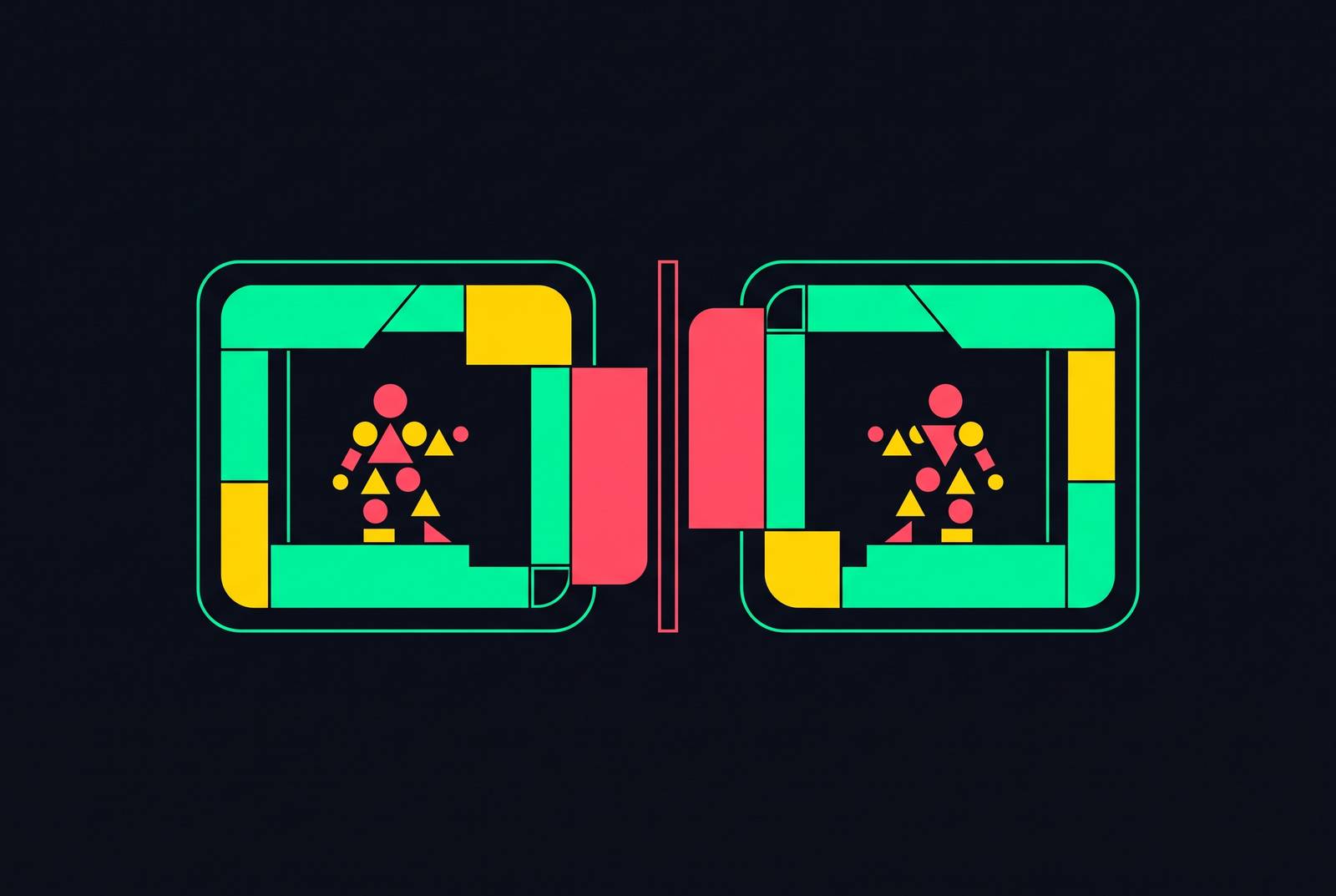
Agents don't just answer questions. They log into systems, call APIs, run business logic, and act on delegated credentials without anyone standing over them approving each step. That's what makes point-in-time, single-category testing the wrong model for this problem, and it's why isolated twin environments have become the fix that actually holds up: they copy the agent's real tool access and credential context into a space cut off from production, so an attack can run to completion, a fix can be checked against that same attack, and an approved workflow can be confirmed unbroken before anything ships.
Ferrag et al. (2025) counted more than 30 distinct attack techniques against agentic systems, spanning input manipulation, model compromise, system and privacy attacks, and protocol-level vulnerabilities. No single category dominates, which is the first thing worth sitting with: a testing program built around one attack class is built around the wrong assumption. Every tool call, every credential handoff, every piece of retrieved context is a fresh point of failure.
Prompt injection gets the most attention, and it earns it. It exploits a basic limitation: the model can't reliably tell an instruction its developer trusts apart from text an attacker slipped into a document, a webpage, or a tool response. OWASP ranked it the top risk in its 2025 Top 10 for LLM Applications, and on the Agent Security Bench the highest average attack success rate reached 84.3% across 16 attack types and 10 scenarios. That's not an edge case. That's most of what's out there, and any testing setup that treats it as a side concern has already lost the argument.
The problem compounds once agents start talking to each other. Prompt injection doesn't stay contained to a single agent: in interconnected systems, a compromised agent can become a vector into the next one, so the attack surface scales with however many agents are wired together, not with any single agent's code. Protocols that let agents discover and call tools dynamically widen that surface further, introducing additional vectors for tool manipulation and credential misuse that extend well beyond any single agent's perimeter.
Some damage is quieter. Gradual behavioral corruption through poisoned context is a related concern, where no single step trips a monitor but the sum of small manipulations pushes the agent somewhere it shouldn't go. Point-in-time testing structurally can't catch that, because there's no single point where the drift becomes visible. Agent marketplaces introduce analogous supply-chain risks, and the security controls that would mitigate them have not kept pace with how quickly those ecosystems are growing.
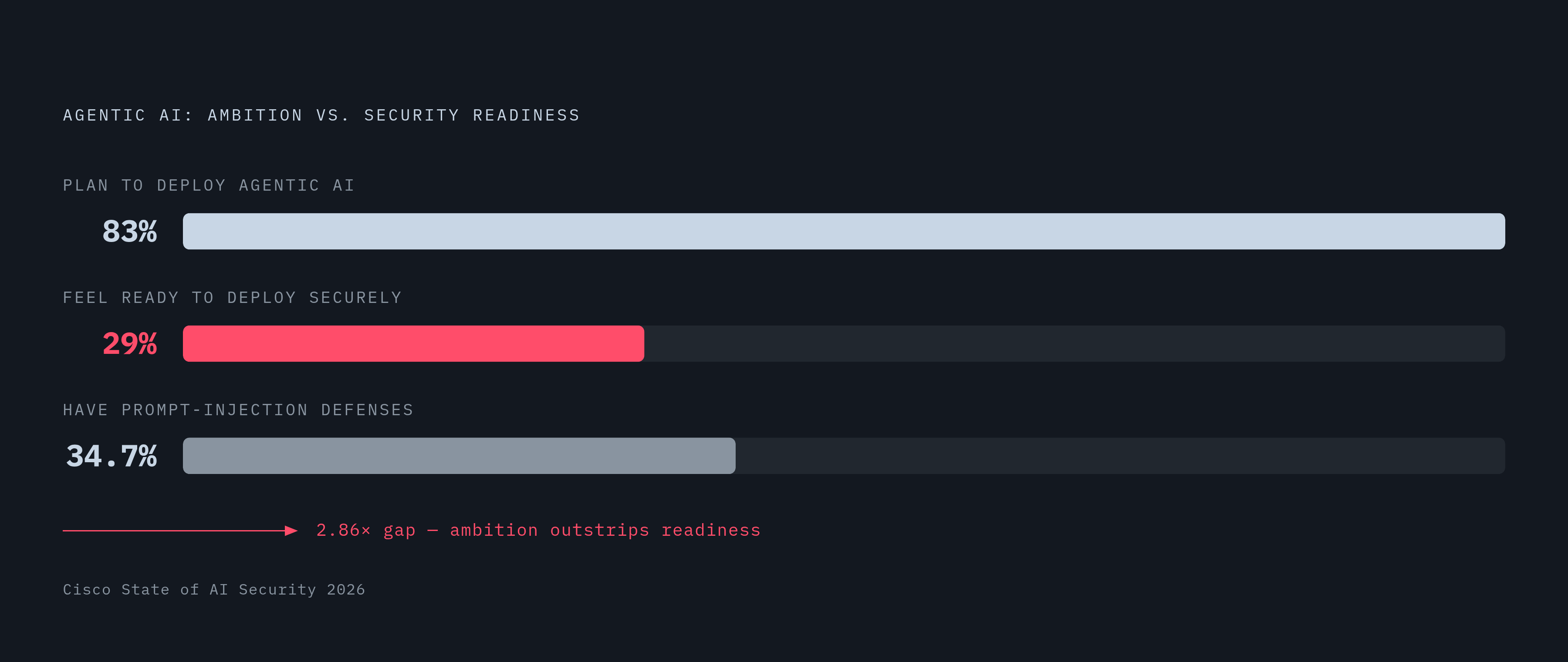
The Cisco State of AI Security 2026 report puts the gap in blunt terms: 83% of organizations plan to deploy agentic AI, but only 29% feel ready to do it securely, and only 34.7% have deployed dedicated defenses against prompt injection. Testing that covers one attack class, or that runs somewhere that doesn't resemble the agent's actual tool surface, misses most of what matters. That's the case against point solutions, full stop.
What an isolated twin environment actually is and how it replicates the production context
A twin environment is a shadow copy of the production agent: same tool surface, same credential structure, same retrieval and prompt setup, but fully cut off from anything that would matter if it broke. "Mirrors" is doing real work in that sentence. It means ephemeral credentials scoped only to the twin, injected at execution time and never written into logs or conversation history. It means network isolation, ideally with data flowing one way. It means treating package proxies, artifact repositories, orchestration systems, and monitoring infrastructure as part of the attack surface, not trusted plumbing sitting safely outside the test.
A container is not a security boundary you can bet production on, no matter how often teams treat it like one. That's the mistake worth naming directly: a single sandbox layer is not isolation, it's a speed bump. Isolation that actually holds up is layered, authentication, authorization, tool restrictions, filesystem isolation, network restrictions, resource limits, runtime isolation, and monitoring, stacked together rather than any single wall standing in for all of them. An agent shouldn't automatically inherit the trust level of the application hosting it, either. A properly isolated runtime sits between the user and whatever tool or task planner the agent is driving.
Alibaba Cloud's AgentBay work (2025) makes the contrast concrete. A standard Linux setup runs the agent directly on the host OS with user-level privileges, which is roughly how most people run agents locally, and it's a bad default, not a neutral one. AgentBay's sandbox instead runs on VM architecture with default-deny network policies. Same agent, wildly different blast radius if something goes wrong. A good isolation boundary is defined by more than whether a single container holds. It's defined by whether a persistent, motivated attacker can chain together an unexpected sequence of smaller weaknesses and defeat every layer at once.
Why the twin must replicate real tool access and credential context, not a simplified stand-in
Swap real tools for stubs and the test stops answering the question that matters: would the agent actually follow a malicious instruction all the way through a real tool call, against real authorization logic on the other end? A stub can't tell you that. It only tells you what the model does when nothing is actually at stake, which is a different and much less useful question, and treating it as equivalent is the second common mistake in this whole discipline. Some platforms built around this gap, like Armorer Labs, a continuous security verification tool for AI agents that proves real attacks inside isolated twin copies of an agent before applying any fix, exist precisely because stubs obscure the answer teams most need.
AgentDojo, built by researchers at ETH Zurich, is instructive because of how it's put together. It combines an LLM agent, a tools runtime, mutable environment state, and a generator that produces both user tasks and injection tasks. The environment state has to be mutable, and tool outputs have to be adversarially augmented at specific injection points, or the whole exercise degrades into theater. AgentDojo's adversary model assumes full knowledge of the tool APIs and system prompts but no visibility into the agent's internals or its API traffic, a realistic picture of what a real attacker knows going in. A stub environment can't reproduce that, because there's nothing real underneath for the attacker to have knowledge about.
AgentDojo's own numbers show what's at stake in getting this right. Claude 3.5 Sonnet hits 78% benign utility. GPT-4o's utility drops from 69% to 50% once it's under attack. That utility-security tradeoff is only measurable because the tools runtime is real enough for the agent to actually complete tasks, succeed sometimes, fail sometimes, get compromised sometimes, all in the same test run.
SandboxEval (Rabin et al., 2025) makes a related point from the code-execution side. It's a suite of handcrafted scenarios testing whether an LLM's code-execution environment leaks sensitive information, allows filesystem manipulation, or permits unauthorized external communication. Detecting whether an agent can leak sensitive information or manipulate the filesystem requires a real environment with those properties in place, which a simplified stand-in simply doesn't have.
The credential question sits underneath all of this, and it has exactly two wrong answers. Fictional credentials in the twin mean a successful exploit proves nothing about production, since it might just be exploiting a hole that doesn't exist anywhere real. Credentials shared with production mean a successful exploit in the twin is a production incident, full stop. Ephemeral credentials, scoped only to the twin session and to nothing outside it, are the only setup that avoids both failure modes at once.
How isolation makes attack reproduction possible, and why reproduction is the standard that matters
Isolation is what gives testers permission to be aggressive. Because the twin is cut off from anything that matters, an organization can run active exploitation attempts and follow an attack path all the way through without worrying about what happens if it succeeds. That containment is the license, and without it, testing quietly reverts to theoretical description, which is a much weaker thing to build a release decision on.
A reproduced attack answers four questions a theoretical finding can't. Is the vulnerability reachable given this agent's actual system prompt and tool configuration? Does the attack succeed end to end, including against whatever defenses are already in place? What does the agent actually do once the attack succeeds, what tools does it call, what data does it touch, what happens downstream? And can the same attack run again, deterministically, to confirm a fix actually stops it?
DoomArena, from ServiceNow Research and published at COLM 2025, was built to separate the attack itself from the details of any one environment, so the same attack replays across different environments and still means something. It also supports composable attacks, stacking previously published attacks together for finer-grained testing. That modularity is the difference between a one-off finding and a testing practice someone can actually rely on.
One of DoomArena's findings should worry anyone leaning on a single guardrail as their main line of defense: LlamaGuard failed to catch any of the attacks in the study, including indirect prompt injection attacks it wasn't even designed to detect. A guardrail passing a snapshot check can still miss systematic exploitation entirely, and running the exploit against it is the only way to find out before an attacker does.
There's a second failure mode worth separating out here: false positives. Stanford's 2025 ARTEMIS study found that even the best-performing AI agent carried an 18% false-positive rate in live network testing across roughly 8,000 hosts. Hallucinated exploits are documented, not theoretical, and this is precisely where twin-based testing earns its keep: a hallucinated exploit doesn't execute against a real tool. It just fails, visibly, and gets filtered out by the requirement that an attack complete rather than merely look plausible on paper.
All of this feeds a verified change record: a document that captures the tested agent version, the model provider, the tool policy, the retrieval configuration, the abuse cases run, and what happened when they ran. That record is only honest if the attacks behind it actually happened, in a controlled environment, in a way someone else could rerun and get the same result.
How verified fixes stay minimal and don't break approved workflows
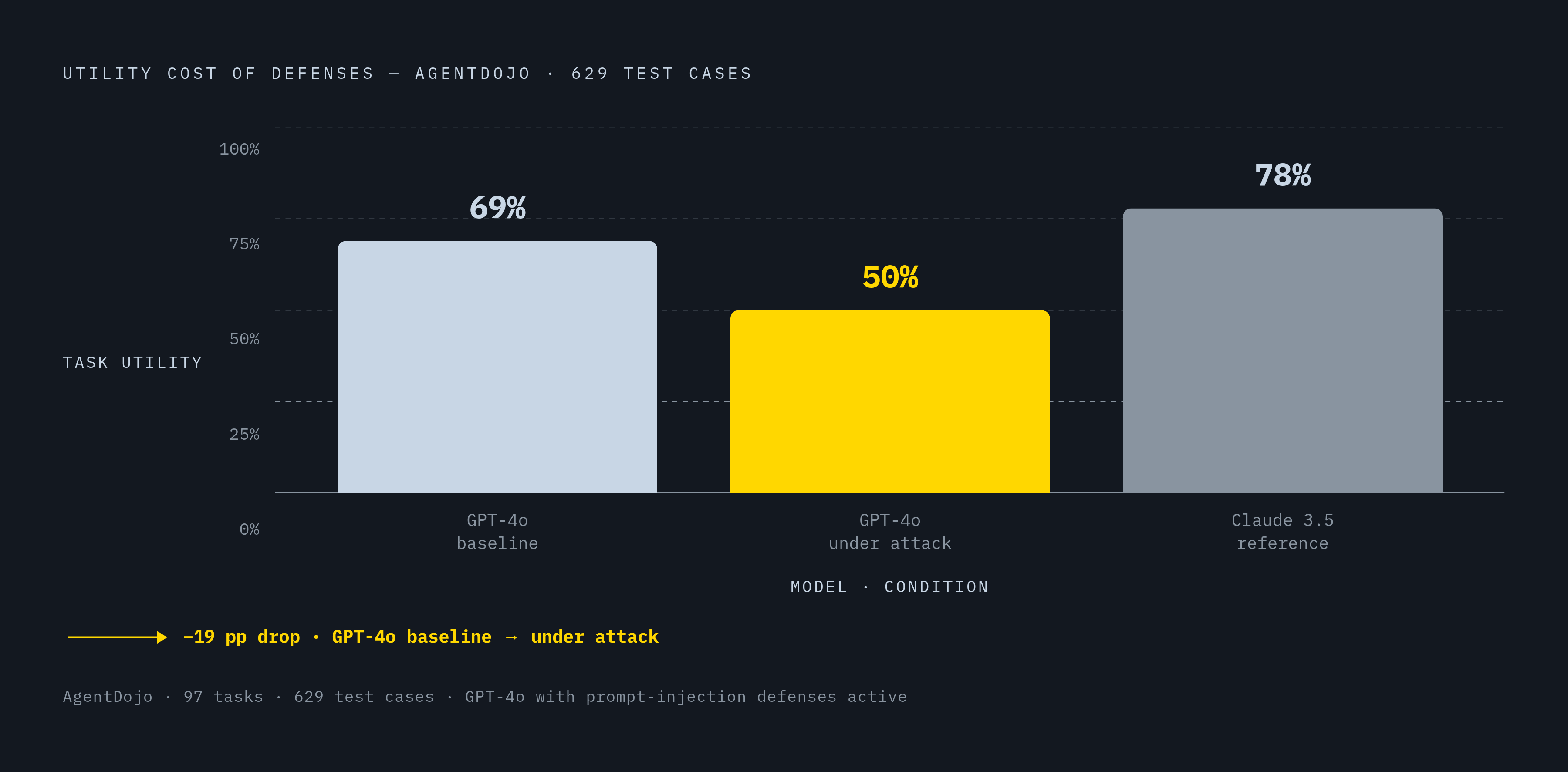
Security and usefulness pull against each other, and the AgentDojo numbers already show it: across a 97-task, 629-test-case benchmark spanning email, banking, travel, and workspace domains, defenses that cut down vulnerability also cut into task-completion utility, with GPT-4o dropping from 69% to 50% once attacks entered the picture. That tradeoff is measurable, not speculative. "Apply the strongest defense available" sounds cautious, but it's the wrong default: an overly broad safeguard that breaks the workflows people actually rely on gets rolled back or quietly bypassed within weeks. Either way, it stops protecting anything, and a fix nobody's using is worse than no fix, because it creates the illusion of coverage where there isn't any.
The twin is where that gets sorted out properly, and the sequence matters. A candidate fix goes into the isolated environment first, and the original attack runs again to confirm it no longer works. Then every approved workflow runs through the same environment, with the fix still in place, to confirm nothing legitimate broke along the way. If an approved workflow fails under the new safeguard, the fix is too broad, and it gets narrowed inside the twin, not in front of real users. DoomArena was built with this same tradeoff in mind: the same framework that proves an attack succeeded can also be used to evaluate whether candidate defenses preserve ordinary, benign task completion.
Safe use in production, per the Strobes checklist, calls for non-destructive read-only validation, a kill switch that's actually been tested rather than assumed to work, human approval before high-risk actions, and full audit logging. None of that is safe to test live. All of it is testable in a twin, which is exactly the point of building one.
A 2026 industry survey found the share of organizations willing to hand testing entirely to AI automation fell from 29% to 9% over the course of a year. That's not caution for its own sake. It's a market correcting toward governed autonomy, where a human still checks the output, and a human reviewer needs something concrete and reproducible to check against, not a summary someone wrote after the fact.
What current benchmarks and frameworks reveal about gaps in existing testing approaches
AgentDojo, developed by researchers at ETH Zurich and presented at NeurIPS 2024, remains the most rigorous public benchmark for prompt injection against tool-calling agents, with 97 tasks and 629 security test cases spread across email, banking, travel, and workspace domains. Its design reflects realistic attacker assumptions, but it's still one benchmark, and treating any single benchmark as a universal answer is exactly the error teams keep making.
DoomArena, from ServiceNow Research and presented at COLM 2025, describes itself as the only agentic security testing framework meeting all six of its own evaluation criteria: support for AI agents, stateful multi-step simulation, multiple attack types, plug-in environments, fine-grained threat modeling, and modular attack integration. It plugs into BrowserGym, τ-bench, and OSWorld, which is a large part of why it's become a reference point rather than a one-off tool.
HackWorld (Ren et al., 2025) tested computer-use agents against 36 vulnerable web applications spanning 11 frameworks and found that even state-of-the-art agents exploited fewer than 12% of the targets through visual interaction alone. That gap, between how these agents perform on curated benchmarks and how they perform against messy real-world targets, matters more than any single benchmark score, and it's the reason benchmark results should be read as a floor, not a ceiling.
The other side of that coin is what a well-resourced, autonomous attacker can do. At the Dragos OT CTF 2025, the CAI agent placed first, with a 37% velocity advantage over elite human teams, meaning autonomous agents can find and exploit operational-technology vulnerabilities faster than human defenders can patch them. That's a warning about the pace defenders are up against, and it argues for testing infrastructure that moves at a comparable speed rather than lagging a generation behind.
What these frameworks share is that they run attacks inside controlled, isolated environments. That isn't incidental, it's the reason their results mean anything at all. What none of them fully resolve: decision drift building up across sessions, supply-chain attacks moving through agent marketplaces, or the case where the isolation boundary itself becomes something an attacker can exploit. Those stay named, acknowledged gaps rather than solved problems. Earlier tools like ToolEmu (Ruan et al., 2024) and AgentSims (Lin et al., 2023) simulated external APIs and synthetic tasks, useful for early-stage evaluation, but they're simplified stand-ins, not full replicas of a real tool surface. Mistaking one for the other is where a lot of testing programs quietly go wrong.
The governance layer that makes twin-based testing a release-ready artifact
A test nobody can audit or rerun carries no evidentiary weight. It's a claim, and claims are cheap next to a record someone else can check line by line. The twin's real value shows up at the end of the process, in what it produces for a reviewer to check against: a record of what was tested, how, and what happened.
OWASP's AI Agent Security Cheat Sheet spells out what that record needs. It should include the agent version under test, the model provider, the tool policy, the retrieval configuration, the specific abuse cases run against it and what they were expected to do, and whether each case ended in approval, denial, timeout, or a circuit breaker tripping. A Verified Change Record is the document that satisfies that specification, and it only means something if the testing behind it happened in a controlled, replayable environment. Skip the replayability and the record is just paperwork.
Human sign-off sits on top of that record, not on top of a live session. Nobody merges code without a person reviewing the record first, which keeps a human in the loop on every change reaching production instead of trusting an automated pass or fail. The kill switch gets tested before the agent's first real run in the twin, not assumed to work because someone wrote it into a design doc. Credentials for the agent under test follow least-privilege rules by default: scoped per session, injected only when needed, never logged or written anywhere a later process might read them back.
That 2026 drop in organizations trusting AI automation fully for testing, from 29% to 9%, points at where this is heading. Most organizations now want a human checking AI-generated findings before they count for anything, and the Verified Change Record is what makes that check something a person can do in a reasonable amount of time, rather than a bottleneck piling up unreviewed. The whole approach rests on one practical requirement: if a different reviewer runs the same twin configuration against the same agent version with the same attack, the result has to match. That's what reproducible actually means when a release decision is riding on it.
Sources
- AI Agent Pentesting: 7 Checks Before You Authorize
- Cybersecurity AI: The World's Top AI Agent for Security Capture-the-Flag (CTF)
- DoomArena: A framework for Testing AI Agents Against Evolving Security Threats
- AgentBay: A Hybrid Interaction Sandbox for Seamless Human-AI Intervention in Agentic Systems
- cheatsheetseries.owasp.org
- arxiv.org