Workflow Regression Testing After AI Agent Security Changes
Security controls can silently break legitimate workflows that agents were approved to run.
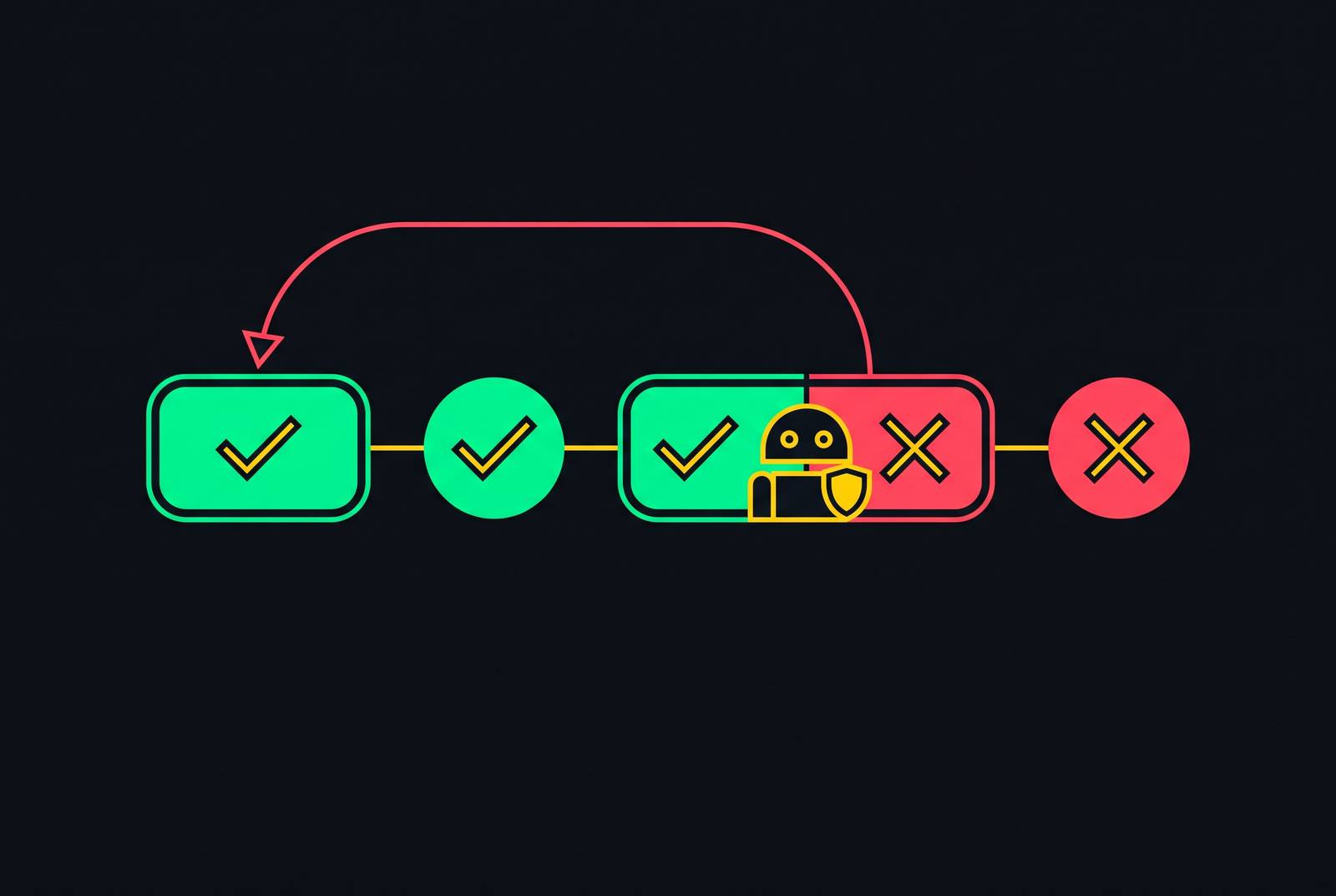
Applying a security control to an AI agent solves half a problem. The other half is proving that every workflow the agent was already approved to run still works after the change, and that proof requires its own testing discipline, separate from the one used to justify the security fix in the first place. Agentic systems are non-deterministic enough that even a narrow, well-targeted safeguard can quietly break a legitimate task, and nothing about deploying the fix tells you whether that happened.
The reason this matters starts with how these systems behave at runtime. Ask an agent to do the same thing twice, and you can get two different tool call sequences back, sometimes because the model version shifted, sometimes because the context window filled up differently. A safeguard added to stop one behavior sits on that same probabilistic surface as the agent it's protecting. It doesn't distinguish cleanly between "malicious" and "legitimate" the way a firewall rule distinguishes between a blocked IP and an allowed one. It can suppress a phrasing pattern, a tool call shape, or a permission scope, and take out a legitimate workflow that happened to resemble the thing it was built to stop. Worse, nothing raises an error when this happens. The agent still completes an action. It just isn't the right one.
What makes agentic systems distinct enough to need their own regression discipline
An AI agent isn't a static service sitting behind an API contract. It takes instructions from multiple sources at once, some of them untrusted, holds authenticated access to real tools, carries memory across sessions, can spawn subagents, and takes actions that have consequences outside the sandbox it runs in. That's a different shape of system than the one classical regression testing was built for, and the difference shows up the moment a security change goes in.
Classical regression testing assumes a fixed input-output contract: same input, same output, forever, until someone changes the code. Agentic regression can't assume that. Four things break the assumption directly. Outputs are probabilistic, so the same workflow prompt can produce different tool call sequences run to run. Execution happens in multiple steps, so a safeguard applied at step two of a seven-step chain can quietly change what steps three through seven see. Memory and retrieval pipelines feed the agent's beliefs, not just its words, so a control that touches what goes into or out of a RAG system changes what the agent knows. And in multi-agent deployments, a constraint on one agent changes the inputs a downstream agent receives, so the failure shows up somewhere nobody was watching.
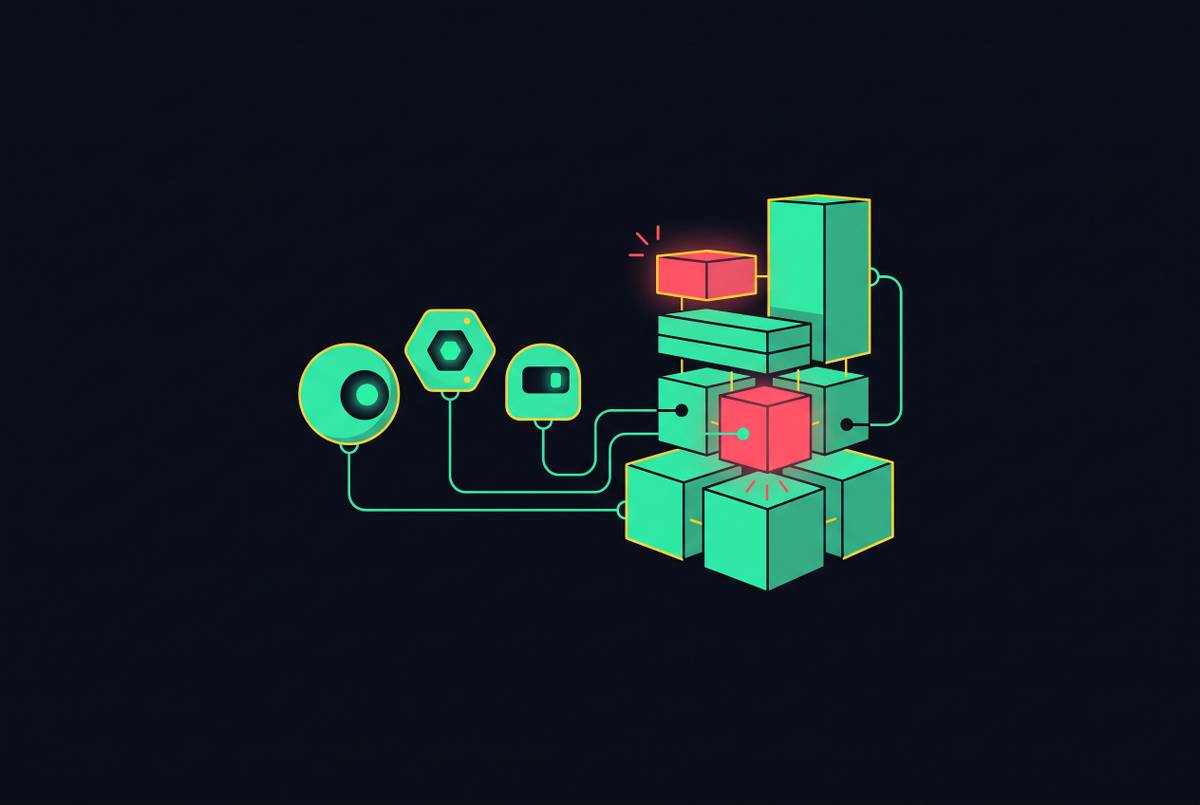
The Cloud Security Alliance's MAESTRO framework, published in February 2025, breaks agentic systems into seven interdependent layers: Foundation Models, Data Operations, Agent Frameworks, Deployment and Infrastructure, Evaluation and Observability, Security and Compliance, and Agent Tools and Integrations. The point of decomposing it that way is that a change at any one layer can produce an observable effect at any other. MATRA's OpenClaw case study makes the same point from a different angle: architectural controls like network sandboxing and least-privilege access do reduce risk by shrinking the blast radius of an attack, but they also change which tool calls succeed, and that has a direct effect on whether a workflow still produces the outcome it's supposed to. Regression coverage, then, has to span the whole execution path, prompts, tool calls, memory reads and writes, API interactions, inter-agent messages, not just whatever text the model happens to output at the end.
The specific ways a minimal security control can silently break a legitimate workflow
Five failure patterns show up often enough to name individually.
A prompt injection guardrail built to catch adversarial instructions can flag a legitimate user request that shares words or structure with a known attack pattern. This gets worse with indirect injection defenses: a control that sanitizes retrieved documents to stop instructions hidden in a RAG source can just as easily strip out data the workflow actually needed to complete its task.
A least-privilege control meant to stop data exfiltration can revoke a permission that a legitimate workflow was quietly relying on for a benign write. Agents tend to pick up permissions as their task list grows, so pulling one back rarely has a single, contained effect. It touches whatever else was built on top of it.
A safeguard that clears or quarantines memory to prevent poisoning can wipe out context a multi-turn workflow needs to keep track of where it is in a task. The workflow doesn't fail loudly here either. It just forgets, and produces a plausible-looking but wrong answer.
Changing a system prompt to constrain the agent's goals shifts the probability distribution across the agent's entire output space, not just the narrow behavior the change was targeting. MITRE's ATLAS framework catalogs this under technique AML.T0081, Modify AI Agent Configuration, which covers how agent configuration changes can affect system behavior beyond their intended scope.
And in multi-agent setups, a control applied to an orchestrator changes the instructions, context, or tool access a downstream subagent gets, breaking workflows that never touched the changed component directly. The subagent didn't do anything differently. Its inputs did.
What ties all five together is silence. The agent runs, produces an output, raises no exception, and the workflow is broken anyway. That silence is exactly why workflow regression testing after a security change counts as a mandatory step. It's the only thing standing between "we shipped a fix" and "we shipped a fix that also broke three things nobody noticed."
What counts as an approved workflow and how to define one precisely enough to test
An approved workflow is a specification of what the agent is supposed to do. It's a recorded, reproducible trace of what it actually did when it worked correctly, covering the triggering prompt, the full sequence of tool calls, the arguments passed to each one, the memory reads and writes that happened along the way, any messages sent to other agents, and the final output or action taken.
The trace level matters because two runs can land on the same final answer through very different paths, and only one of those paths might be safe. A regression test that only checks the destination misses this entirely. It has to check the route.
Capturing this well means treating execution logs as production artifacts in their own right: versioned, stored, tied to whatever security baseline they were recorded against. Not every workflow needs the same kind of test either. Some are deterministic-path workflows, where the tool call sequence stays stable run after run given the same input, and those are straightforward to regress with exact trace matching. Others are variable-path workflows, where the agent reaches a correct outcome through different sequences depending on the run, and those need a defined envelope of acceptable paths rather than a single expected trace. And some are memory-dependent, where correct execution depends on what's already sitting in the agent's memory before the workflow even starts, which means the test setup has to reproduce that memory state, not just fire off the triggering prompt.
Teams that haven't been logging tool-call-level execution have nothing to regress against. Logging belongs inside the testing effort itself. It's the precondition for the testing effort existing at all. The teams treating this seriously in 2025 apply the same discipline to prompts that used to be reserved for production code: versioned, tested, audited, and the same discipline extends to the execution traces that define what "correct" looked like.
How to structure regression test suites specifically for post-security-change verification
The working principle is simple to state: prove a finding once, then freeze it as a regression test. The attack proof that justified the security change and the workflow regression test that verifies it didn't break anything else are two halves of the same change record, not two separate efforts.
Structure the suite by how far the security change reaches. Tier one covers direct-path workflows, the ones using the exact tool, memory store, prompt pattern, or permission the change touched. Every one of these has to run; this is where breakage is most likely. Tier two covers adjacent-path workflows, the ones that share a downstream dependency with whatever changed, where a tool's output feeds into something else, or memory that got modified gets read somewhere unrelated. Tier three covers cross-agent workflows, run by subagents that take their context from a modified orchestrator. This is the tier where failures show up last, because nothing about the subagent's own code changed. Only its inputs did.
For every workflow in the suite, three things need to be defined before it runs, namely the expected tool call sequence or acceptable envelope, the expected final action or output class, and whatever memory or retrieval state has to be present or absent for the run to count as valid. Variable-path workflows need to run multiple times, with results checked against the approved envelope across all of them. One passing run tells you almost nothing about a probabilistic system. It tells you that run passed.
Existing frameworks give some structure here rather than requiring everything built from scratch. AgentDojo is a full-runtime evaluation benchmark built to measure both benign task success and adversarial robustness for tool-using agents, useful specifically for checking that approved task success rates hold after a control goes in. The Inspect AI framework, hosted on GitHub, provides scaffolding for running structured evaluations against agent behavior more generally.
This is a build that recurs rather than a one-time undertaking. When the underlying model updates, or a new tool gets added, the suite has to run again against the new baseline. A pass recorded against last month's model version says nothing about whether the same workflow is safe against this month's. Organizing the suite by change type, rather than running it as one undifferentiated batch, means a narrow security fix triggers a targeted but complete regression run, not a quick spot check that happens to miss the tier where the actual damage landed.
What the test environment must reproduce to make results meaningful
Testing the model in isolation proves almost nothing. The environment has to reproduce the full surface the agent actually runs against: the tool endpoints it can call, including sandboxed versions that return realistic responses rather than stubs that always succeed; the memory and retrieval state, meaning the actual contents of the vector store or knowledge base the agent would read from mid-workflow; the inter-agent message channels, with subagent stubs that behave the way the real subagents behave; and the system prompt and configuration exactly as deployed, security changes included.
Running these tests against a live production agent creates its own problem. Security changes then interact with real data, real credentials, and real tool side effects, so a failed test has real consequences, and a passed test that relied on live state that no longer exists can't be reproduced by anyone checking the work later.
The alternative is an isolated twin: a full replica of the production agent's runtime surface, sandboxed so tool calls execute safely but still realistically. Exploits get proven against the twin without risk. Approved workflows get verified against it without touching production state. Reproducibility here is a requirement. It's the entire basis on which a release approver can trust that the regression results in front of them reflect what will actually run once the change ships.
Testing a single node, model output alone, and calling it done leaves the rest of the execution graph unchecked. The evaluation has to map decision chains, tool calls, and API interactions across the whole path, not just the final line of text the model returns. And before running the suite after any security change, the twin's configuration needs a parity check against production. Drift between the two environments is itself a source of false positives and false negatives, and it's an easy thing to miss because the twin still looks like it's working.
How regression results become a release decision rather than an internal quality signal
Without a structured result set, a release decision about a security change comes down to an engineer's sense that things look fine. That's an opinion, not evidence, and it doesn't hold up when someone asks for the basis of the call six months later.
A credible release record needs a few specific things in it. The attack that justified the change, proven against the isolated twin, not described in a paragraph but recorded as an exploit replay log. The minimal safeguard that was applied, and the specific component it touched. The regression suite that ran against it, which tiers, which workflows, how many runs for the variable-path cases. The pass or fail result for every workflow in the suite, with the execution trace kept alongside it. And for anything that failed, a record of how it got resolved before the change was approved.
The approver reviewing this needs to be able to reproduce the result independently, not take a summary on faith, but re-run the suite against the same isolated twin and land on the same outcome. That's what makes the approval mean anything. Human sign-off and reproducibility aren't procedural overhead sitting on top of the real engineering work. They're the mechanism that keeps a security change auditable and reversible after the fact. A process that lets changes merge automatically, with nobody checking whether the regression results were even real, removes the only check that exists.
Gravitee.io's April 2026 survey found that most security leaders report pressure to deploy AI agents fast, even when the security work isn't fully done. A structured, reproducible release record is what lets a team move at that speed without giving up the evidence trail entirely, which is the problem Armorer Labs, a continuous security verification platform for AI agents that proves real attacks against isolated twins and delivers Verified Change Records for human release approvers, was built to solve. It's not a brake on velocity. It's the thing that makes velocity defensible later.
The record does one more job worth naming. Every workflow verified against every security change becomes a permanent regression baseline going forward. The next change doesn't start from a blank slate. It runs against an expanding set of proven passing cases, and the suite gets more valuable with each round it survives.
Where regression testing reaches its limits and what must be named rather than hidden
A suite that passes every workflow in it doesn't prove the agent is safe. It proves the workflows that were defined still pass. Those are not the same claim, and treating them as the same claim is where regression testing starts to mislead rather than inform.
What it doesn't catch: workflows nobody ever recorded as an approved baseline, so a legitimate use case that existed before the security change but was never captured has no test protecting it now. Novel attack paths that slip through the gap between the control and some undocumented workflow, since the suite only covers what was explicitly scoped into it. Emergent behavior that shows up only in multi-agent compositions that weren't present when the baseline was recorded, the kind of thing the "Agents of Chaos" red-team study by Shapira and colleagues documented in 2026, tracing how unsafe behavior propagated across agents in live, persistent-memory environments. And model-version drift: a suite validated against one model isn't automatically valid after that model updates, because the probabilistic surface shifts even when the system prompt and the tools stay exactly the same.
Prompt injection in particular has no complete fix. Even frontier models remain vulnerable after the best available defenses are applied. Regression testing confirms the safeguard holds for the workflows that were tested.
The honest move is to name every blind spot directly in the release record: which workflow categories weren't covered, which model-version combinations were never tested against each other, which inter-agent paths were stubbed instead of fully simulated. Naming these gaps demonstrates that the methodology is working as intended. It's the information an approver actually needs to make a risk-calibrated call instead of a falsely confident one. Workflow regression testing closes a real gap between applying a security control and knowing what it actually did. Naming its limits is what keeps that gap from quietly reopening under a false sense that it was closed for good.