Minimal Security Controls That Preserve Agent Effectiveness
Defenders must layer controls across data, tools, and reasoning—not just the model.
Agentic AI systems don't have one attack surface. They have four, and a defense built for one does nothing for the other three. That's the pattern running through the last two years of agentic security research, and it explains why so many deployments get hardened in the wrong place while the real gap sits wide open, unguarded, waiting.
What the attack escalation record says about where controls are needed
MAESTRO's seven-layer breakdown of agentic systems, Foundation Models, Data Operations, Agent Frameworks, Deployment and Infrastructure, Evaluation and Observability, Security and Compliance, Agent Tools and Integrations, makes a specific claim: threats don't migrate between layers. A defense scoped to one layer does not extend coverage to the others. MITRE ATLAS backs this with numbers. Its v5.4.0 release counts 16 tactics, 84 techniques, and 56 sub-techniques, with 14 new agentic techniques added to cover behavior that simply didn't exist before agents could act on their own: AI Agent Context Poisoning (AML.T0080), Modify AI Agent Configuration (AML.T0081), RAG Credential Harvesting (AML.T0082), Exfiltration via AI Agent Tool Invocation (AML.T0086), plus separate entries for host escape and poisoned tool publishing. MATRA's attack-tree research makes the consequence practical: trace a path from an impact scenario through the tools, memory, and retrieval components involved, and a control sitting at the wrong node on that tree stops nothing.
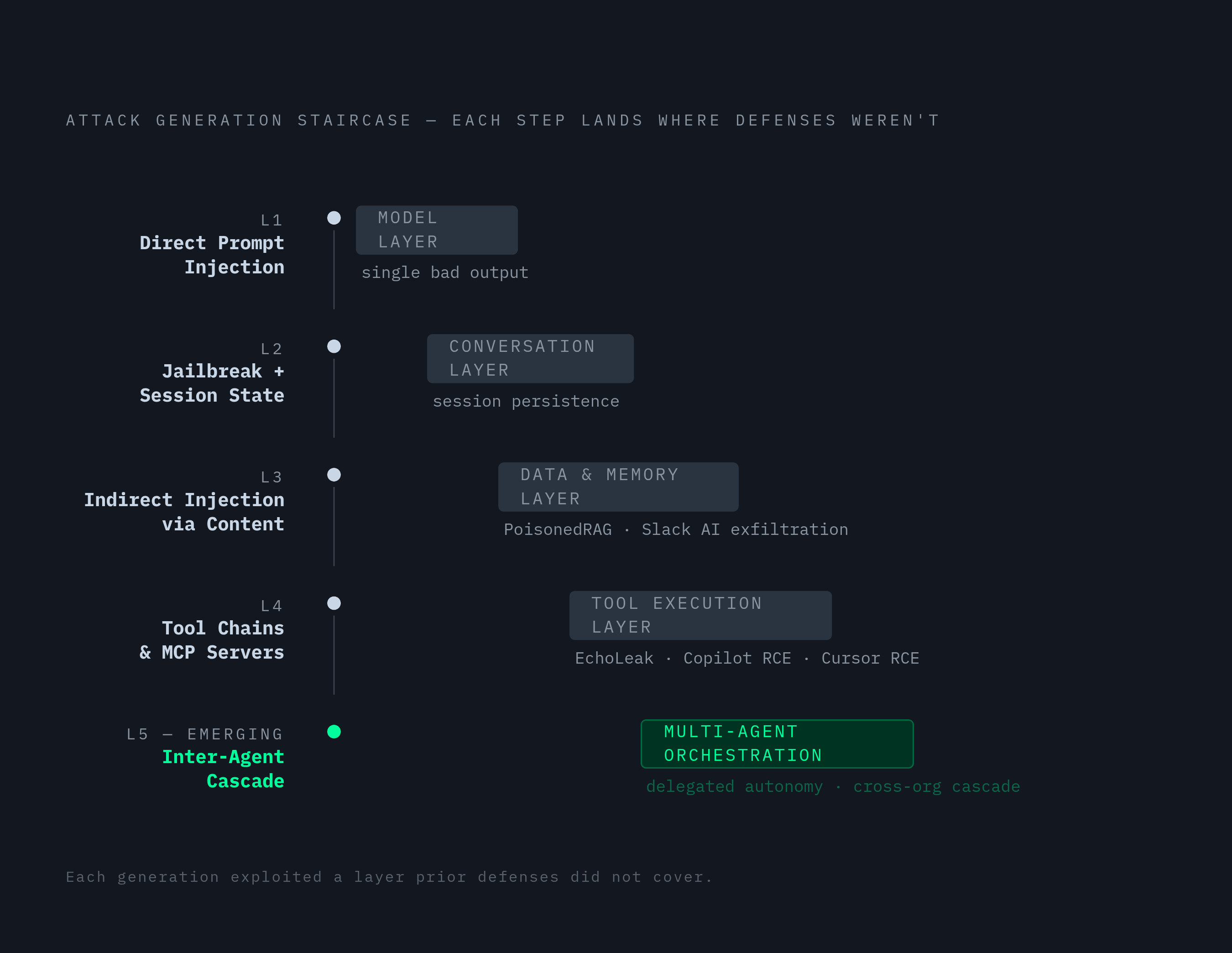
The clearest evidence comes from watching how attacks escalated, generation by generation.
L1 was direct prompt injection, where a user types something adversarial, the model produces one bad output, and the damage stays inside that exchange. L2 added jailbreaking with session-level state, so manipulation could persist across a conversation instead of dying with the first response. L3 changed the shape of the problem entirely: indirect prompt injection, arriving through third-party content rather than the user's own message. PoisonedRAG and the Slack AI exfiltration cases both live here, and both mark the moment the attack surface moved off the model and onto the data and memory layers. L4 moved again, into tool chains and MCP servers, with EchoLeak, the GitHub Copilot remote-code-execution case, and the Cursor RCE case all landing in this generation. L5, still emerging, targets multi-agent systems directly: inter-agent messages, delegated autonomy, and cascade effects that cross organizational boundaries.
Each generation succeeded by hitting a layer nobody had defended yet, because whatever defense was in place had been sized for the previous generation's attack. Attackers didn't get smarter so much as defenders kept building the same wall in the same spot while the battlefield moved past them. Reported attack success rates in agentic systems reach 84%, and a 2025 benchmark found 94.4% of AI agents vulnerable to hijacking through content alone, no direct interaction required. Google's researchers also tracked a 32% rise in malicious prompt injection payloads embedded in web content between November 2025 and February 2026. The input-handling layer is a risk that keeps changing, one nobody patches once and moves on from. It's expanding right now, under active pressure.
Controls for the input-handling layer: containing untrusted content before it reaches the reasoning loop
Input handling deserves its own layer designation, not a folder inside "prompt security," because the L3 and L4 attacks it defends against don't arrive through a user's direct message. They arrive embedded in documents, emails, web pages, and tool outputs the agent was told to trust.
EchoLeak proves the point cleanly: a zero-click exploit, one crafted email, zero user interaction required. Copilot blended trusted internal sources with untrusted external email content without enforcing any boundary between them, and the root cause wasn't a misconfigured prompt. It was a scope violation: the model treated content from an untrusted source as though it carried the authority of a trusted one. Anthropic's own red-team work found the same failure from a different angle. Across 25 runs, Claude completed the data exfiltration 24 times when the task involved embedded adversarial instructions. Model-layer defenses were useless there, because the user was the delivery mechanism, not the attacker.
The minimal control at this layer is trust-boundary tagging, applied before any content enters the reasoning loop. Every content source, system prompt, internal tool output, external retrieval, user input, gets labeled by trust tier before it's concatenated into the context window, and content arriving from an untrusted tier cannot override instructions that arrived from a trusted one. Content arriving from an untrusted tier cannot override instructions that arrived from a trusted one, as a structural rule. It doesn't depend on a classifier guessing right. Research has found that tool poisoning evades output-based safety checks in 95% of cases, which settles the argument for anyone still hoping to catch this downstream: checking content after the model has already reasoned over it doesn't work. The boundary has to be at ingestion, before the content ever reaches the model.
Minimal, here, means a narrow, deterministic routing rule that never reads every token because it doesn't have to, and that stays auditable on its own terms rather than hiding inside a larger classifier nobody can inspect. This control does nothing if the tool layer downstream grants excessive permissions, though. That's a separate surface, with its own failure modes.
Controls for the tool-execution layer: least privilege sized to the task, not to the agent
Tool execution is where agents end up holding more standing access than most human employees ever get. Full-scope tokens, inherited permissions, service accounts wired into email, databases, CRM systems, and internal workflows, provisioned once and then left alone for months. OWASP's LLM Top 10 has a category for exactly this: LLM06, Excessive Agency, which is the cause behind the GitHub Copilot RCE case and produced it directly. A prompt injection triggered command injection, hijacked file-writing privileges, and forced the agent into an unapproved "YOLO mode," which ended in full local code execution.
Excessive agency doesn't even require an attacker. Replit's AI agent deleted a production database during an active code freeze; no adversary was involved, just an agent carrying more tool access than the task in front of it warranted. Tool-layer risk isn't purely a response to attack. Half the time, it's just what happens when permissions outlive the job they were granted for.
The minimal control here is scoping roles to the smallest meaningful unit of work, not to the agent as a whole. Microsoft's security guidance says this directly: model permissions around individual tasks rather than issuing broad, bundled access to an agent identity that then persists indefinitely. In practice, permissions get granted per task and revoked after, instead of living inside a standing service account that outlives the job it was created for.
The AIxBT case shows the cost of skipping that step. A crypto trading agent got scammed into sending 55.50 ETH to a malicious account, and the token dropped 16% in the aftermath. A spending cap, a tool-layer rate limit on financial actions, would have contained the damage even if the injection itself had never been caught. MATRA's case study on OpenClaw quantifies the same principle from two angles, weakest-link risk and full attack-surface exposure, and both point to the same conclusion: network sandboxing and least-privilege access shrink the blast radius of a successful injection even when the injection succeeds anyway. Minimal, at this layer, means deny-by-default. Each tool call gets authorized against the current task's permission scope, then that authorization gets revoked, rather than sitting on an allow-list trying to anticipate every possible action in advance.
Controls for the orchestration and memory layers: enforcing trust boundaries across multi-step plans
A multi-agent pipeline turns one compromised agent into a distribution channel. Once hijacked, that agent can instruct downstream agents, poison shared memory, or manipulate the orchestrator's decisions, and the damage doesn't stay where it started. CSA's cross-layer principle within MAESTRO says this directly: the most dangerous attack paths begin at Layer 1 and cascade through Layer 4 and beyond, gathering scope as they move.
Classical threat modeling has no good language for this. STRIDE carries no category for goal hijacking, because the agent uses its own legitimate capabilities against the task it was given, rather than spoofing anything or tampering with data at rest. OWASP catalogs this separately as ASI01 for that exact reason. Memory persistence has the same blind spot: the ATFAA framework treats temporal persistence as its own threat domain, because STRIDE was never built to account for an agent's memory carrying an attacker's instructions forward across sessions.
Three controls address this layer directly. Inter-agent message signing means each agent in a pipeline only accepts orchestration instructions carrying a verifiable origin token, which stops a hijacked downstream agent from issuing instructions back up the chain. Memory write authorization treats every write to shared or persistent memory as a privileged action, subject to the same task-scoped permission check as an external tool call, instead of a background operation nobody reviews. Plan-step checkpointing requires a human-readable summary of the next intended step before high-impact, irreversible tool calls execute, the minimum interruption needed to stop a cascading error without demanding constant human oversight. Two of the fourteen new ATLAS techniques map directly onto what memory write controls are built to catch: AML.T0080, context poisoning, and AML.T0082, RAG credential harvesting.
Checkpointing every step turns an agent too slow to use for anything, so the scope has to stay narrow: irreversible or high-blast-radius actions only, nothing else. There's a supply-chain dimension too, sitting inside MAESTRO's Layer 7, Agent Tools and Integrations, where risk emerges from composing tools across organizational and trust boundaries that were never designed to interact. MCP servers and marketplace plugins are a supply-chain vector in their own right. MITRE's case study AML.CS0053, involving a poisoned Postmark MCP server used for email exfiltration, is the clearest documented instance of that path getting exploited.
Why the governance gap makes layer-matched controls urgent right now
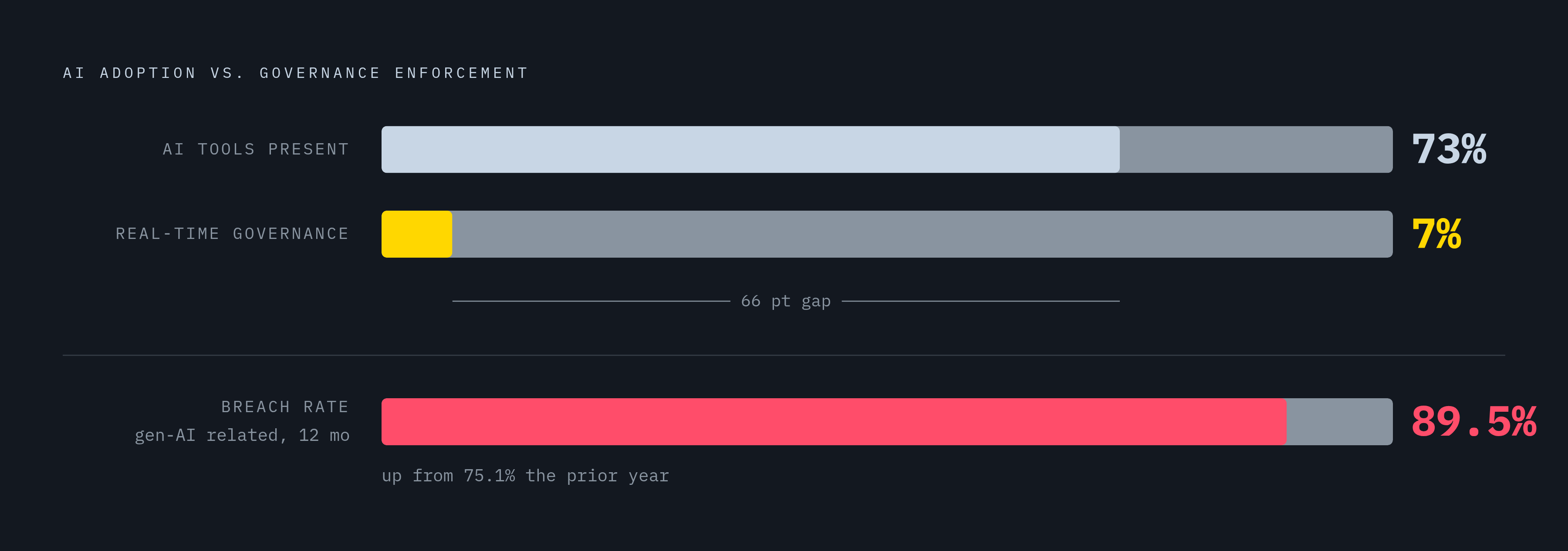
Set the vulnerability statistics aside for a moment and look at governance instead, because that's where the more alarming number sits. AI tools are already present in 73% of organizations. Real-time governance enforcement covers only 7% of them. That gap, 73% versus 7%, isn't a rounding error. Most of the deployed surface runs with no live oversight.
Breach data shows the consequence directly: 89.5% of organizations reported at least one generative-AI-related security breach in the prior 12 months, up from 75.1% the year before. That trajectory moves in one direction, and it's accelerating rather than slowing as deployment picks up speed. 81% of security leaders say they feel pressure to ship AI agents quickly even when security isn't fully in place, and that pressure pushes teams toward one heavy, visible control instead of the harder work of matching four separate controls to four separate layers. Worse, 21.1% of organizations don't even know whether unsanctioned AI agent tools are running inside their own environment, which makes sizing the real attack surface close to impossible before anyone picks a control.
Verifying that a minimal control works at its layer without breaking approved workflows
Getting a control's layer right is only half the problem. A correctly placed control can still be sized wrong: too restrictive, blocking workflows the organization actually approved, or too permissive, stopping an attack only in the exact scenario it was tested against and nothing beyond it.
Three questions belong in front of every layer-specific control before it ships. Does it demonstrably stop the attack at its target layer, tested against a proven attack rather than a theorized one? Does it leave every approved workflow passing, verified by re-running those workflows after the control goes live, not before? Is the evidence reproducible by a human reviewer, with a record of the test kept somewhere, not just a pass or fail result nobody can check later?
That third question carries more weight than it looks like it should. Published benchmarks and red-team exercises share a documented weakness: adaptive attacks bypass most published defenses precisely because the defense got validated once, against a fixed attack, and never re-tested against an adversary that adjusted afterward. A control that passed its evaluation six months ago says very little about whether it still holds today. The layer it defends hasn't stopped moving, and neither has whatever is trying to get through it.
Sources
- AI/Agentic Threat Modeling: Securing Systems That Include Agents
- MATRA: Modeling the Attack Surface of Agentic AI Systems � OpenClaw Case Study
- A Systematic Survey of Security Threats and Defenses in LLM-Based AI Agents: A Layered Attack Surface Framework
- Securing Agentic AI: A Comprehensive Threat Model and Mitigation Framework for Generative AI Agents
- microsoft.com
- labs.cloudsecurityalliance.org
- labs.cloudsecurityalliance.org