AI-Generated Threat Intelligence Signals in Enterprise SOCs
Attackers are injecting malicious instructions into threat signals produced by AI agents.
AI-generated threat intelligence signals are only as trustworthy as the agents that produce them, and that premise is now the central operating risk inside enterprise security operations centers. SOC teams have quietly crossed a line: agents are no longer just analyzing threat intelligence, they are generating it. The agent has become the source rather than the filter. That distinction changes everything downstream: a signal that looks legitimate may reflect attacker-injected intent rather than the agent's designed behavior, and the output is indistinguishable without provenance tracing.
The older generation of AI-assist tooling stayed advisory. It suggested, an analyst decided, and the system had no hands. That's gone. Agents today reach directly into ticketing systems, query internal databases, open pull requests, and trigger automated workflows, mostly without a human checking each step. Cisco's State of AI Security 2026 shows this level of connectivity has become normal, not exceptional.
Governance has not caught up. The Sophos AI Security 2026 Report, published July 22, 2026, states that AI identities have become a new attack surface, and that security policy has not kept pace with the speed of adoption. Signal provenance, in other words, has become a first-order security question rather than a footnote. When an agent produces an alert or enriches an indicator, the integrity of that output depends on everything the agent touched on the way to producing it, and attackers already understand this dependency better than most defenders do. The rest of this piece traces that failure mode from its root cause through its concrete exploitation, and closes on what a defensible validation framework actually demands of the teams running these agents.
How AI agents acquired privileged access inside enterprise environments
The scale of this shift is not gradual. GenAI traffic inside enterprise environments has risen more than 890 percent, Palo Alto Networks' 2026 predictions found, with the browser now functioning as what the firm calls an "AI front door" executing agentic tasks on the user's behalf Palo Alto Networks 2026 Predictions. Layered on top of that, BeyondTrust research cited in the Sophos report found a 466.7 percent increase in active AI agents inside enterprise environments over the past year alone BeyondTrust research cited by Sophos. Adoption did not creep. It surged.
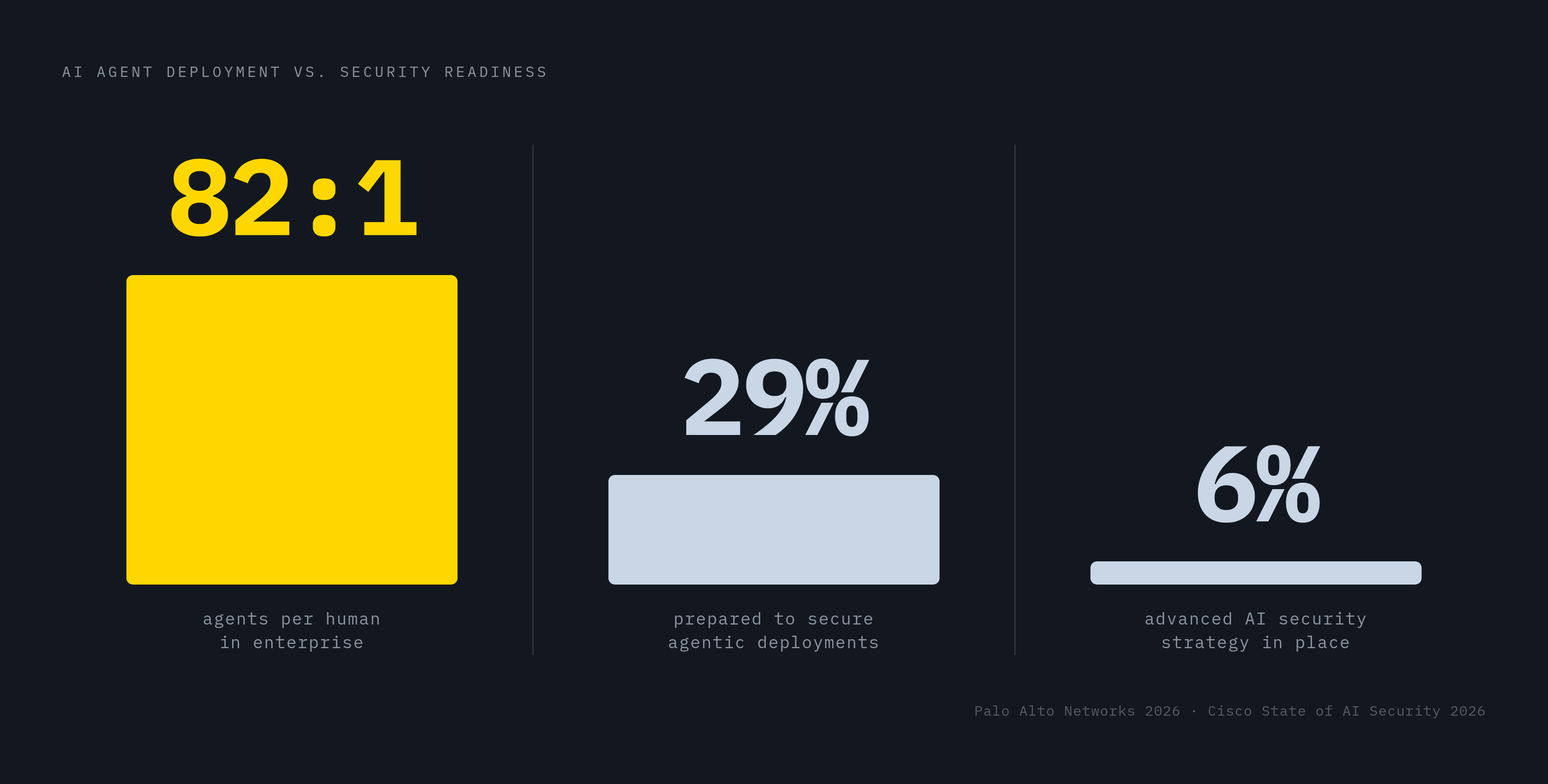
Privileged access, in practical terms, means agents wired into ticketing systems, source code repositories, chat platforms, and cloud dashboards, capable of opening pull requests, querying internal databases, booking services, and triggering workflows on their own. Palo Alto Networks now puts the ratio of autonomous agents to humans inside enterprise environments at 82 to 1, a number that makes manual, per-agent human review a mathematical impossibility at current staffing levels Palo Alto Networks 2026 Predictions. No security team reviews eighty-two machine actors for every analyst on shift Palo Alto Networks 2026 Predictions. That ratio alone should reframe how SOC leadership thinks about trust.
Readiness has lagged badly behind deployment. Cisco's State of AI Security 2026 found only 29 percent of organizations reported being prepared to secure agentic deployments, and the majority of this privileged access was granted before any meaningful control structure existed to govern it Cisco State of AI Security 2026. That sequencing, access first, controls later, is why every agent functions as a machine account with persistent API access, and legacy identity management was never built to handle authentication and authorization at this volume or velocity.
The structural reason AI-generated signals can be manipulated at the source
None of this would matter as much if large language models could reliably tell instructions apart from data. They can't. Any content an agent processes, an email, a document, a retrieved record, a tool's output, can be interpreted by the model as an instruction, and OpenAI has publicly acknowledged this as one of the frontier security challenges the field has yet to solve. That is a structural property of how these systems parse language, not a patchable bug in one vendor's product.
For a SOC agent producing threat intelligence, that structural flaw sits directly in the workflow. The same pipeline that ingests emails, external feeds, documents, and tool outputs to enrich a signal is the exact surface an attacker can manipulate. Research accepted for the MATRA paper at DeMeSSAI 2026 and EuroS&P 2026 makes this explicit: agentic pipelines blur the boundary between instruction and data, leaving agents susceptible to being steered by whatever untrusted content they happen to process while doing their assigned task.
Simon Willison's 2025 formulation of the "lethal trifecta" names the exact combination that makes this dangerous: access to private data, exposure to untrusted content, and the ability to communicate externally. Combining those three conditions describes, almost exactly, a SOC agent that enriches signals from external threat feeds and posts the results to a shared dashboard. It satisfies all three conditions by design, not by misconfiguration.
The numbers back up how seriously the field takes this. Prompt injection is at the top of the OWASP Top 10 for LLM Applications 2025, and attack success rates inside agentic systems have reached 84 percent in testing, with production exploits carrying CVSS scores above 9.0 Vectra AI. A signal that looks legitimate, formatted correctly, confidently scored, properly attributed to a MITRE technique, may in fact reflect an attacker's injected intent rather than the agent's intended behavior. Without provenance tracing, a signal reflecting attacker-injected intent and one reflecting the agent's designed behavior are indistinguishable.
The five-level escalation from simple prompt injection to multi-agent signal poisoning
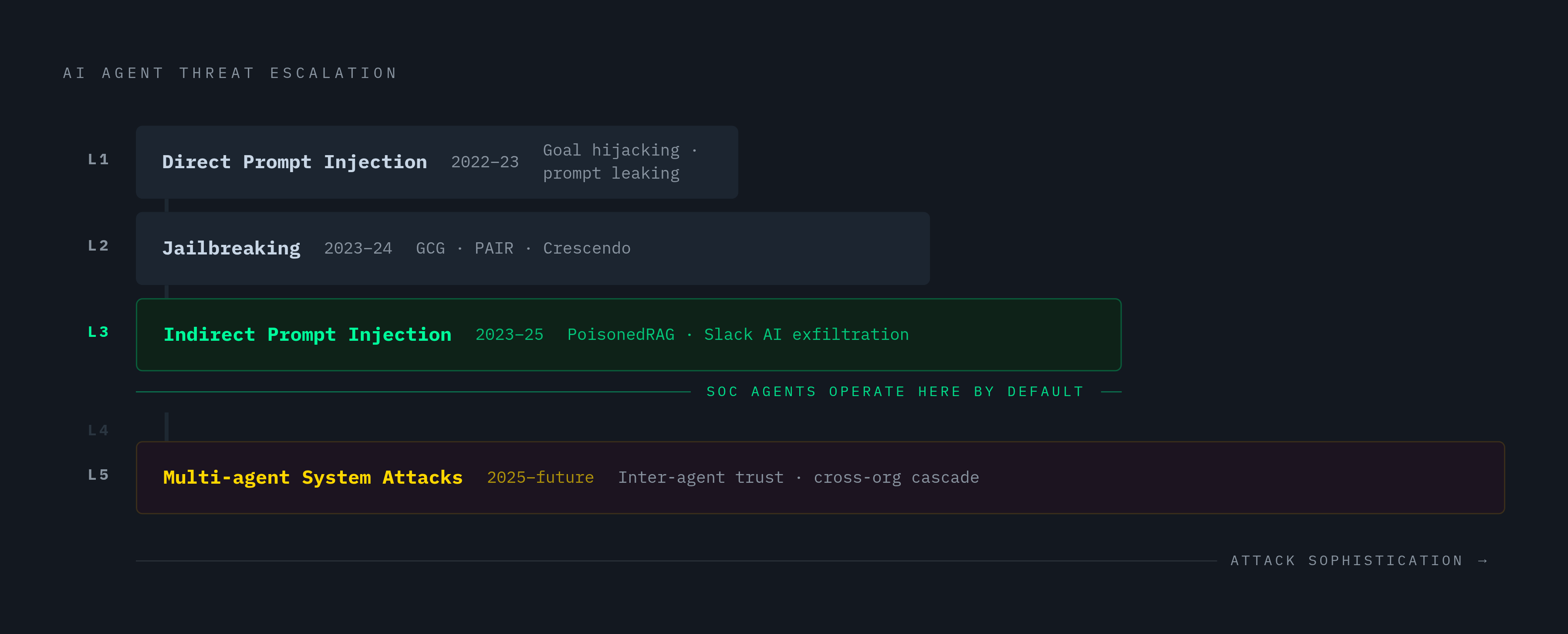
Researchers mapping this threat in 2026 describe it as a five-level escalation model of increasing sophistication.
Level three is where SOC operations actually live. Any SOC agent pulling from threat feeds, Slack channels, email summaries, or RAG-retrieved documents is operating in this territory as a matter of design, not as an edge case.
That cascade risk is not abstract. The OWASP Top 10 for Agentic Applications 2026, its ASI01 category specifically, describes how a hijacked agent can propagate its compromise downstream, poisoning shared memory, manipulating orchestrator decisions, and instructing subsequent agents in a pipeline. L1 (Direct Prompt Injection, 2022–23) involved goal hijacking and prompt leaking, with the attacker having direct interface access. L2 (Jailbreaking, 2023–24) encompassed GCG, PAIR, and Crescendo techniques, bypassing model-level constraints. L3 (Indirect Prompt Injection, 2023–25) included PoisonedRAG and Slack AI exfiltration, in which the attacker embeds payloads in content the agent retrieves. L5 (Multi-agent System Attacks, 2025–future) involves inter-agent trust exploits with cross-organization cascade potential. The OWASP Agentic Top 10 for 2026 taxonomy, developed with more than 100 industry experts, includes ASI01 (Agent Goal Hijack), ASI02 (Tool Misuse and Exploitation), ASI05 (Unexpected Code Execution), and ASI09 (Human-Agent Trust Exploitation), all directly applicable to signal-generation pipelines. The MITRE ATLAS October 2025 update added 14 new techniques and sub-techniques specifically addressing AI agents and generative AI systems, the taxonomy the piece should point practitioners toward for red-team planning. The next section shows what L3–L4 attacks look like against real production systems.
Zero-click prompt injection against production AI systems SOCs already use
EchoLeak, tracked as CVE-2025-32711 with a CVSS score of 9.3, disclosed in June 2025 against Microsoft 365 Copilot, stands as the first documented zero-click prompt-injection data-exfiltration flaw found in a production large language model. A crafted email, processed during routine Copilot summarization, contained hidden instructions that pulled files from OneDrive, SharePoint, and Teams and exfiltrated them through a Microsoft Teams proxy domain that Copilot's own content security policy allowed. Nobody clicked anything. The summarization step, the exact workflow SOC agents use to triage alerts and enrich indicators, was the attack surface itself.
CamoLeak followed a similar logic against a different product. Tracked as CVE-2025-59145, CVSS 9.6, found in GitHub Copilot Chat in June 2025, patched in August, and disclosed in October, the exploit hid prompts inside pull-request descriptions using invisible markdown comments. Those hidden instructions caused Copilot Chat to encode private repository secrets as a sequence of pre-computed image URLs, routed through GitHub's own Camo image proxy, which the victim's browser fetched and which reconstructed the stolen data on the attacker's server. Legit Security found it.
Four named zero-click chains reached disclosure and patching in 2025: EchoLeak against Microsoft 365 Copilot, CamoLeak against GitHub Copilot Chat, ShadowLeak against ChatGPT Deep Research, and ForcedLeak against Salesforce Agentforce. Separately, Claude Code carried its own vulnerabilities, CVE-2025-59536 and CVE-2026-21852, which enabled remote command execution and API key theft. Agentic coding tools, in other words, now carry a normal CVE lifecycle and need patching discipline like any other production software. The infrastructure connecting agents to tools has its own scars too: CVE-2025-6514, disclosed in July 2025, describes a malicious MCP server achieving full remote code execution, CVSS 9.6, against any client running the mcp-remote package.
None of these incidents required breaching a perimeter. Each one worked by injecting content into a channel the agent was already designed to consume, then letting the agent's own legitimate credentials do the rest. A Dark Reading poll for 2026 found 48 percent of security professionals now rank agentic AI as the top attack vector for the year, and these incidents are the reason why Dark Reading poll 2026.
MCP tool poisoning's threat to signal integrity at the infrastructure layer
The Model Context Protocol has become the backbone connecting AI models to external tools, data sources, and automated workflows across the enterprise in 2026, and it is the exact layer through which SOC agents call threat feeds, SIEM APIs, and enrichment services. That makes it a high-value target, and the poisoning mechanism works precisely as follows. A malicious MCP server embeds natural-language instructions inside its tool descriptions. The agent loads those descriptions at initialization and folds them into its system context before a single user message has been typed. The payload executes before the conversation even starts.
The Postmark MCP incident illustrates the downstream consequence. A compromised server injected a hidden BCC field into email tool calls, silently exfiltrating outgoing email content to an attacker-controlled address over an extended period before anyone caught it. That is a direct analogue for how a poisoned threat-intelligence tool call could quietly redirect enriched indicators to an address that has no business receiving them, all while the dashboard upstream looks entirely normal.
Scale matters here too. In May 2026, OX Security disclosed what it called "the mother of all AI supply chains," a systemic vulnerability across Anthropic's MCP implementations in Python, TypeScript, Java, and Rust, affecting an estimated 200,000 vulnerable MCP instances spread across IDEs, internal tools, and cloud services OX Security disclosure. Research presented at AAAI 2026 quantified just how effective this manipulation can be: a malicious MCP server shifted model outputs toward policy-violating completions with a mean attack success rate of 73 percent, turning an ecosystem-layer compromise into a straightforward alignment bypass AAAI 2026 research. MCP alone logged 99 CVEs in 2025 GitHub AI Red-Teaming Guide.
An API layer that most organizations are not watching closely produces the conditions for the failures that follow. Prophaze's AI Security Threat Report 2026 found APIs under management grew 167 percent year over year, while only 7.5 percent of organizations run a dedicated API threat-modeling program ProPhaze AI Security Threat Report 2026. That means the MCP attack surface sits on top of an API estate that 92.5 percent of organizations monitor without dedicated tooling built for the job ProPhaze AI Security Threat Report 2026. An API gateway can confirm a call is well-formed, properly authenticated, and within its rate limit. It has no way to tell whether the natural-language prompt riding inside that call is attempting to override system instructions or steer the agent toward something nobody authorized.
The shadow AI governance gap and signal provenance
Governance failures compound the technical exposure. Prophaze's 2026 report found 78 percent of AI users bring their own tools to work, so shadow AI enters through the API layer entirely outside procurement, security, or legal review AI Security Threat Report 2026. Every one of those tools, sanctioned or not, spins up a non-human identity with persistent API access, and these identities are multiplying faster than security teams can inventory them. Legacy identity management was built around human logins and session-based trust. It was never designed for machine-to-machine authentication at this scale, and it shows.
Sophos frames the consequence directly: the identity fabric connecting AI services to enterprise systems creates exposure that existing governance simply was not built to handle, with OAuth tokens, AI service credentials, developer tools, and exposed AI infrastructure all now sitting in an attacker's target list. Sophos goes further and names the exact risk this piece has been describing: compromised AI identity access could be used to "gently manipulate or poison enterprise AI tools, subtly directing them to perform actions for the benefit of the attacker." That is the operational description of signal poisoning, written by a vendor watching it happen.
The population operating under this exposure is not a small, unlucky minority. Palo Alto Networks found only 6 percent of organizations have an advanced AI security strategy in place, meaning nearly everyone acting on AI-generated signals today is doing so without mature governance behind them Palo Alto Networks 2026 Predictions. Gartner expects more than 40 percent of agentic AI projects to be cancelled by 2027, citing escalating costs, unclear business value, and inadequate risk controls, a figure that shows governance failure is already killing projects outright and creating theoretical security risk MIT State of AI in Business 2025 / Gartner. And the clock has compressed sharply: the median cloud attack chain now completes in under ten minutes, while the average breach lifecycle still stretches to 258 days before discovery, Prophaze's 2026 findings show AI Security Threat Report 2026. The decision point has moved to runtime. The window to catch a poisoned signal before it propagates through a dashboard, a ticket, or a downstream agent is measured in minutes.
Requirements of a rigorous signal validation framework for SOC teams operating AI agents
Signal integrity has to be verified at the point of production, not assumed from the agent's identity or its credentials. An agent's legitimacy proves it was authorized to act. It proves nothing about whether the output it just produced was manipulated along the way.
Threat modeling has to happen before deployment, not after an incident forces the question. The MATRA framework, accepted at DeMeSSAI 2026 and EuroS&P 2026, offers a concrete method: asset-based impact assessment paired with attack trees that trace paths from a specific impact scenario back to the concrete attack vectors available across tools, memory, and retrieval components. It quantifies, rather than merely asserts, how architectural controls like network sandboxing and least-privilege access shrink the blast radius of a successful compromise.
Least-privilege enforcement matters as much for agents as it ever did for human accounts. Sophos recommends treating AI agents exactly like human users: access restricted to only what the task strictly requires, with manual verification required before an agent gains entry to any new area. That single discipline limits how far an injection can travel even when it succeeds. Behavioral monitoring closes the remaining gap; Sophos recommends alerting on suspicious behavior or unexpected data exfiltration tied to AI agent identities specifically, because a behavioral anomaly is often the only signal available that an agent has been redirected from its intended task.
None of this resolves through argument alone. Whether a specific agent inside a specific workflow can actually be exploited is a question that opinion cannot settle, only a demonstrated attack against an isolated replica of the deployment can. The MAESTRO framework (CSA, February 2025) and MITRE ATLAS (15 tactics, 66 techniques, 46 sub-techniques, updated October 2025) provide the taxonomy structure for structuring agent-specific red-team tests. The five-level escalation model applies runtime verification before production to L3–L5.
Sources
- 2026 Predictions for Autonomous AI
- Agentic AI: Biggest Enterprise Security Threat for 2026
- AI Agents Now the Enterprises Fastest Growing Exposed Attack Surface
- MATRA: Modeling the Attack Surface of Agentic AI Systems – OpenClaw Case Study
- AI Security Threat Report 2026: Growing Attack Surface
- github.com
- itecsonline.com
- vectra.ai